
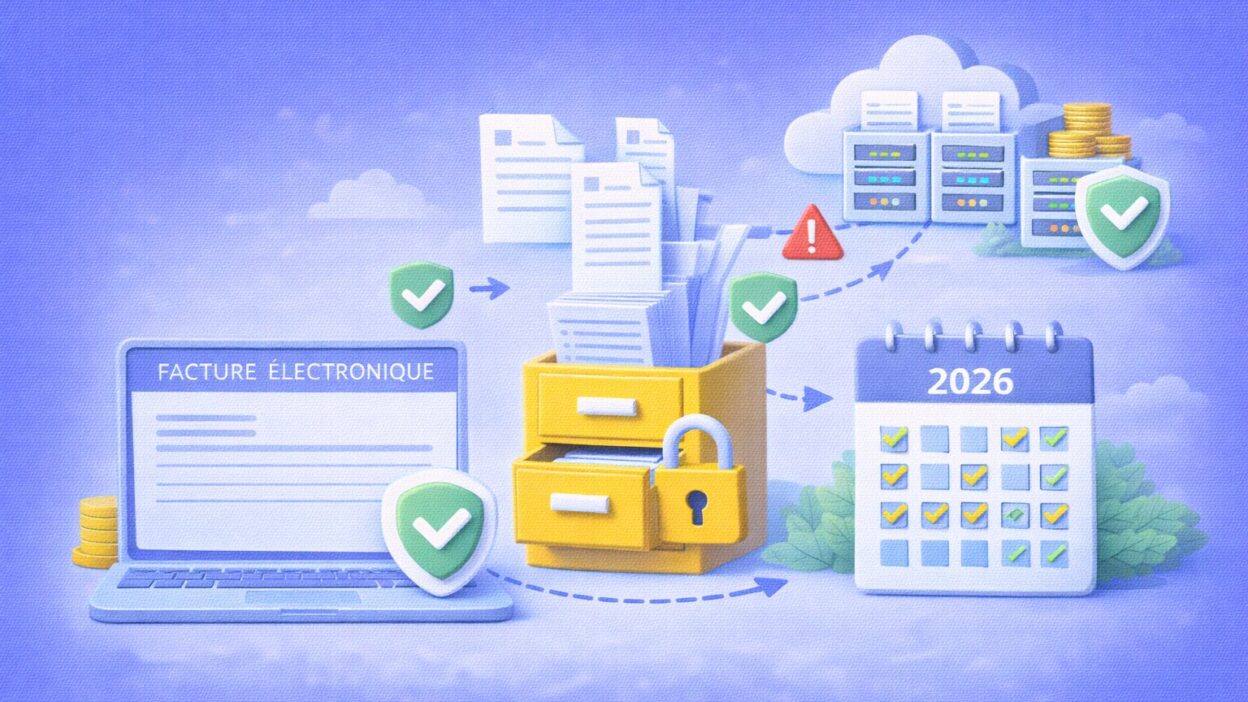
The electronic invoicing reform, whose deadline looms on the horizon of 2026, is undoubtedly one of the most significant regulatory transformations for French VAT-registered companies. Often perceived initially as a constraint for the issuance of customer invoices, this profound transformation impacts just as much, if not more, the way companies receive and store their supplier invoices. It is precisely on these aspects, often underestimated, that the most important operational risks and most critical compliance challenges concentrate for financial management teams.
As of September 1, 2026, the receipt of electronic invoices will become a legal obligation for all companies, regardless of their size or sector of activity. It will no longer simply be a matter of opening a PDF file received by email, but of integrating structured data flows, transiting through approved platforms and subject to automatic controls. In parallel, the requirements for storing these documents are significantly strengthened, imposing strict conditions in terms of integrity, traceability and accessibility over legal periods extending up to ten years.
This article aims to guide companies through the complexities of this reform. We will explore in detail the implications of mandatory receipt, the reasons why it constitutes risk number one, and the unavoidable requirements for legal compliant storage. We will review storage options, the crucial importance of Factur-X, UBL and CII formats, before highlighting frequent errors to avoid. Finally, we will propose a pragmatic approach to secure all these processes, thus transforming an obligation into a genuine driver of financial performance and sustainable compliance for your organization.
⏱️ The Essential in 2 Minutes
- The receipt of electronic invoices becomes mandatory for all VAT-registered companies starting in September 2026.
- An electronic invoice is a structured data flow (XML, Factur-X), not a simple PDF, transmitted via the official circuit (Approved Platforms, PPF).
- Legal storage requires integrity, traceability, readability and accessibility of invoices (including structured data) for 6 years (fiscal) to 10 years (accounting).
- Receipt represents operational risk #1: high volumes, heterogeneity of senders, automatic rejections impacting payments and cash flow.
- Avoid storing only the PDF and neglecting invoice status tracking; compliance is decided upstream, through automatic controls.
- Adopt a coherent architecture: receipt via an Approved Platform, processing in ERP/P2P, and secure archiving for compliant storage.
The 2026 Reform: Mandatory Receipt of Electronic Invoices
The electronic invoicing reform, as introduced by the amended budget law for 2022 and reaffirmed by the revised calendar for 2026, is much more than simple digitalization. It marks a profound overhaul of transactional processes between companies and their interactions with the tax administration. The central pillar of this reform is the obligation to switch to a fully dematerialized and structured invoicing model.
Defining an Electronic Invoice: Beyond Simple PDF
One of the first essential clarifications to make concerns the very nature of an electronic invoice. Too often, an “electronic invoice” is still equated with a PDF sent by email. However, within the framework of the 2026 reform, this definition is obsolete. An electronic invoice, or e-invoice, is a document issued, transmitted and received in a dematerialized form that contains structured data.
These structured data are not intended solely to be read by the human eye. They are designed to be interpreted and exploited automatically by computer systems. The authorized formats in France are primarily the Factur-X hybrid format (which combines a PDF for human readability and an XML file for automatic processing) and the 100% structured formats UBL (Universal Business Language) and CII (Cross Industry Invoice) based on XML (Extensible Markup Language). The objective is clear: to guarantee the authenticity of the invoice’s origin, the integrity of its content and its readability throughout its retention period, while facilitating the transmission and automated processing of tax data.
The General Reception Obligation: September 2026, a Crucial Deadline for All Companies
This is a fundamental point, often overshadowed by discussions on issuance: as of September 1, 2026, all companies subject to VAT in France must be technically capable of receiving electronic invoices from their suppliers. This obligation applies without distinction of size or sector of activity, affecting both large enterprises and SMEs and micro-enterprises.
This universality of the reception obligation is crucial. It means that even if your company is not yet obligated to issue e-invoices (the progressive schedule extends until 2027 for the smallest structures), you must imperatively be ready to receive them as of 2026. Failing to do so exposes you to supplier flow blockages, payment delays, disorganization of your financial teams and, ultimately, pressure on your cash flow. It is the entry point of the electronic invoice chain, and its proper functioning is non-negotiable.
The Official Reception Circuit: Approved Platforms (AP), Public Invoicing Portal (PIP) and Controls
The new paradigm of electronic invoicing relies on a controlled transmission circuit, involving several key actors. The electronic invoice no longer circulates directly from supplier to customer via private channels (email, mail). It now transits through platforms, ensuring security, control and traceability.
The supplier transmits its electronic invoice to its own Approved Platform (AP), formerly known as Partner Dematerialization Platform or (PDP). This AP performs an initial set of compliance controls: format verification, mandatory mentions, data coherence. If the invoice is compliant, it is then routed to the client recipient’s AP. This is when the Public Invoicing Portal (PIP) comes in. The PIP acts as a centralized directory, allowing APs to “find” each other based on the client’s SIREN/SIRET. It also receives essential invoicing data (e-reporting flow) to transmit to the tax administration. However, it is vital to understand that the PIP is not an operational receipt tool for companies. It is a hub for tax information and a directory, but it does not handle the integration of invoices into your accounting systems.
On the reception side, the client’s AP takes over. It performs new controls, ensures the integrity of the flow and makes the invoice available to the company’s information system (ERP, Procure-to-Pay solution, accounting tool). This process ensures that only compliant and authenticated invoices enter the recipient’s system, thus ensuring better data quality and error reduction.
Highlighting the Crucial Importance of Invoice Status Management
An often-neglected but critically important aspect of this new circuit is the management of invoice statuses. An electronic invoice is not static; it evolves through a well-defined lifecycle. Key statuses include “Received”, “Rejected” (if non-compliant), “Accepted”, “Scheduled for Payment”, “Paid” (for e-reporting data). These statuses are shared between APs and the PIP, and they become an integral component of regulatory obligations. They are essential for document traceability, payment tracking, dispute management and, ultimately, for tax administration controls.
Failing to be able to track and manage these statuses exposes the company to major risks: difficulties in justifying payment delays, inability to trace an invoice’s path in case of dispute, and non-compliance with administration requirements. The ability to orchestrate and integrate these statuses in your own systems becomes an operational and legal imperative.
Why Receipt Is the #1 Operational Risk Point
If the electronic invoicing reform initially shone the spotlight on issuance, an in-depth analysis of operational challenges reveals that it is the receipt of supplier invoices that concentrates the highest risks for most companies. This asymmetry between issuance and receipt is a major point of concern for financial management.
Assessing the Impact of High Volumes of Supplier Invoices
The first risk factor is undoubtedly volume. As a general rule, a company receives significantly more supplier invoices than the customer invoices it issues. Where emission processes are often standardized and controlled internally, reception is by nature dependent on an external ecosystem composed of a large number of suppliers.
High volume means greater exposure to potential errors, format issues, and variations in the quality of transmitted data. Each incoming invoice must be processed, controlled, integrated, then archived. Multiply this by hundreds, thousands, or even tens of thousands of invoices per month, and the slightest malfunction becomes a mountain of corrective work and cascading delays. The shift to electronic invoicing does not reduce volume, but transforms it into more demanding data flows.
Analyzing the Complexity Related to Sender Heterogeneity
The second complexity factor lies in supplier heterogeneity. By 2026, all companies, from the largest to the smallest, will be required to issue electronic invoices. However, their level of technological maturity and their ability to produce high-quality invoices will not be uniform.
Some of your suppliers will be equipped with sophisticated ERP systems and APs, generating perfectly structured and compliant Factur-X, UBL or CII invoices. Others, particularly less digitized SMEs/micro-enterprises, might use more basic solutions. This can result in differences in data structuring, omissions of mandatory information or inconsistencies. Your receipt system must be sufficiently robust and adaptable to handle this diversity, identify anomalies and guarantee compliance, regardless of the sender.
Describing the Consequences of Automatic Rejections: Blocked Payments, Extended Delays
This is one of the most direct and critical consequences of a poorly prepared reception: automatic rejections. In the new circuit, a non-compliant invoice (missing mandatory field, incorrect identifier, VAT inconsistency, non-compliant format, etc.) will no longer be “processed anyway” with manual correction afterward. It will simply be rejected by the sending AP, receiving AP or even the PIP, and returned to the supplier.
The consequences are immediate and painful:
- Blocked Payments: A rejected invoice does not enter the accounting and financial processing circuit. The payment process is halted, resulting in significant delays.
- Extended Delays: The time required for the supplier to correct and re-issue the invoice, then for it to transit again and be accepted, significantly lengthens processing and payment delays.
- Supplier Tensions: Payment delays can damage relationships with your suppliers, leading to disputes, potential penalties or degradation of service quality.
- Cash Flow Degradation: If a large number of invoices are blocked, this can create uncertainty about short-term financial commitments and disrupt cash flow management.
Quantifying Indirect Costs: Finance Team Overload, Supplier Disputes
Beyond blocked payments, rejections and reception issues generate significant indirect costs, often underestimated:
- Finance and Procurement Team Overload: Managing rejections and corrections requires considerable time from accounting teams, suppliers and controllers. Instead of focusing on value-added tasks (analysis, optimization), they spend their time on manual corrections, supplier follow-ups and dispute resolution.
- Administrative Costs: Each exchange, each phone call, each email to resolve non-compliance represents a cost in time and resources.
- Productivity Loss: Slowed processes and flow disruptions harm the company’s overall productivity.
- Tax Compliance Risks: Poorly received or unintegrated invoices can result in risks regarding VAT deduction or charge justification in case of tax audit.
In summary, poorly controlled invoice issuance primarily generates internal complexity for the company itself. Poorly controlled invoice reception, on the other hand, has direct external and financial repercussions: it is costly in payment delays, disputes with suppliers and operational overload for teams. This is why financial management must make reception an absolute priority in its preparation for the 2026 reform.

Storage of Electronic Invoices: Key Legal Requirements
With the generalization of electronic invoicing, invoice storage is leaving the purely technical domain to become a major legal and regulatory issue. The simple storage of files on a hard drive or in generic cloud storage is no longer sufficient. Companies must now ensure that their storage practices guarantee the evidentiary value of each invoice over the long term.
Distinguishing Operational Storage and Legal Compliant Archiving
It is crucial to make the distinction between two often-confused concepts:
- Operational Storage: This is the retention of invoices in a system accessible for the company’s current needs. This includes accounting, budget tracking, purchase order reconciliation, internal audits or dispute management. The objective is to be able to consult and quickly use invoices within the framework of daily activities.
- Legal Compliant Archiving: This concept goes far beyond simple access. It aims to guarantee the legal and fiscal value of the invoice throughout its legal retention period. Compliant archiving ensures that the retained invoice is the original, that it has not been altered, and that it can serve as irrefutable proof in case of tax audit, commercial dispute or litigation. It is an obligation defined by the General Tax Code (GTC) and the Commercial Code.
In the context of electronic invoicing, an invoice can be “stored” in your ERP but not be “legally archived” if the conditions of evidentiary value are not met. Both are necessary, but legal archiving requires specific technical and organizational guarantees.
Citing the Mandatory Retention Periods: 6 Years Fiscal, 10 Years Accounting
French regulations impose precise retention periods for accounting and fiscal documents, including electronic invoices. These periods can vary depending on the legal nature of the document:
- 6 Years Under Fiscal Law: In accordance with Article L102 B of the Tax Procedures Book (TPB), books, registers, documents or items on which the tax administration can exercise its right of access and inspection must be retained for a period of six years from the date of the last transaction mentioned in the books or registers, or from the date on which the documents or items were established.
- 10 Years Under Accounting Law: Article L123-22 of the Commercial Code stipulates that accounting documents and supporting documents (of which invoices are part) must be retained for ten years from the closing of the fiscal year.
In practice, for maximum legal security, it is strongly recommended to align with the longest period, namely 10 years, for all your invoices. These periods apply to the invoice in its original form, that is to say the totality of the structured data that compose it, and not merely its visual rendering.
Listing the Fundamental Principles: Integrity, Readability, Traceability, Accessibility
For an electronic invoice to have evidentiary value and be enforceable in case of audit, its storage must respect four fundamental principles, often grouped under the acronym “LITA”:
- Integrity: The content of the invoice must in no way be able to be altered, modified or deleted after its issuance or receipt. Technical mechanisms (such as cryptographic chaining, electronic signature or timestamping) must guarantee this immutability. Any modification, even accidental, would invalidate the document’s evidentiary value.
- Readability: The invoice must be able to be consulted and understood by any human being throughout the retention period. This involves managing the evolution of formats and technologies. Even if the source format is XML, a faithful visual rendering must be able to be generated at any time.
- Traceability: It must be possible to retrace the entire lifecycle of the invoice: who issued it, who received it, when, via which platform, what statuses it went through, and who consulted the document or its history. Traceability is essential to prove compliance of the invoicing process.
- Accessibility: In case of audit, the company must be able to quickly return the invoice in an exploitable format for the administration, including structured data. This accessibility must be guaranteed throughout the legal retention period, without excessive dependence on an obsolete system or a failing service provider.
These principles are not merely recommendations, but legal requirements defined particularly by Article 289 of the General Tax Code and the BOI-CF-COM-10-10-30-20. Non-compliance with these conditions can result in tax penalties, such as rejection of VAT deduction or imposition of penalties.
Explaining Why PDF Alone Is Insufficient for Evidentiary Value
This is one of the major changes of the reform: the electronic invoice is first and foremost a set of structured data. The PDF, even though it is comfortable for human reading, is no longer the sole source of truth, and in many cases, it is insufficient to guarantee evidentiary value. Why?
- XML Data as Source of Truth: In formats like Factur-X, UBL or CII, it is the XML data that contains all mandatory information and is exploited by platforms and the administration. A PDF can be visually correct, but if the associated XML file is missing or contains inconsistencies, the invoice is not compliant.
- Ease of PDF Alteration: A “simple” PDF can be modified relatively easily with common tools, calling into question the integrity principle if no security measure (electronic signature, timestamping) is put in place to guarantee its authenticity.
- Lack of Status Traceability: A PDF does not inherently contain information about the invoice’s lifecycle (statuses “Received”, “Accepted”, etc.), which are nevertheless mandatory to retain.
As a consequence, compliant storage of electronic invoices is not limited to “keeping PDFs”. It involves retaining the entire structured flow, associated data, statuses and all proofs of its authenticity and integrity, all in a system guaranteeing the principles of LITA. Omitting this point is one of the most common and riskiest errors.
Where and How to Store Your Electronic Invoices: Options and Strategy
Faced with the obligation to receive and store compliant invoices, companies naturally ask themselves: what is the best strategy for retaining their electronic invoices? There is no single solution, but rather a combination of approaches that will depend on the company’s size, its existing ERP, its invoice volumes and its objectives regarding automation and legal security.
Comparing the Advantages and Limitations of Storage via an Approved Platform (AP)
Approved Platforms (APs), whether those of the sender or receiver, play a central role in the electronic invoicing circuit. Naturally, they offer storage services for invoices that transit through them.
- Advantages: APs are designed to ensure regulatory compliance of flows, native traceability of exchanges and compliance with required formats. Storage via an AP generally guarantees data integrity from receipt. It is a “turnkey” solution for companies wishing to outsource this constraint.
- Limitations: The retention period offered by APs can be variable and does not always cover the entire 10 years required for accounting archiving. There is dependence on a third-party service provider, with the need to ensure its sustainability and reversibility capabilities. Furthermore, the functionality for daily exploitation of these archives may be limited compared to an accounting tool or ERP. Storage via an AP does not always replace smooth integration into business processes.
Evaluating Integration of Invoices into ERP or Accounting Tool
For many companies, the ERP (Enterprise Resource Planning) or accounting software are the natural systems for storing and processing invoices. The integration of electronic invoices directly into these tools has undeniable advantages.
- Advantages: This ensures perfect operational continuity, with finance teams having direct access to invoices for reconciliation, validation and payment. Integration facilitates automated processing, the generation of accounting entries and budget tracking. It is the most integrated solution for daily management.
- Limitations: The ERP or accounting tool must be capable of managing not only the visual rendering (PDF), but especially the structured data (XML) and the invoice statuses. It is necessary to ensure that these systems guarantee the integrity, immutability and traceability of invoices throughout the legal period. Not all ERPs are natively adapted to the requirements of compliant archiving or the management of different XML formats without specific development or additional module.
Presenting the Benefits of Dedicated Electronic Archiving Systems (EAS)
For companies with large volumes, strict regulatory requirements or a need for maximum legal security, dedicated Electronic Archiving Systems (EAS) represent a solid option.
- Advantages: An EAS is specifically designed for compliant archiving. It provides high guarantees in terms of legal security, data integrity (timestamping, electronic signature, chaining), format sustainability and management of legal retention periods. It is often certified (e.g. NF Z42-026) and can manage reversibility and multi-format consultation over the long term. It is the most robust solution for legal preservation.
- Limitations: The implementation of an EAS can be more costly and complex, requiring careful integration with reception systems (AP) and business tools (ERP/P2P). It is more of a long-term archiving solution than a tool for daily operational invoice management.
| Storage Option | Advantages | Limitations |
|---|---|---|
| Approved Platform (AP) | Native compliance, regulatory traceability, status management, flow security. | Potentially limited retention period, service provider dependency, limited functionality for daily accounting operations. |
| ERP / Accounting Tool | Seamless integration into financial processes, direct access for teams, facilitated reconciliation, daily management. | Need to guarantee data integrity and immutability, sometimes incomplete management of XML formats and compliant archiving requirements. |
| Electronic Archiving System (EAS) | Maximum legal security, long-term compliant preservation, legal duration management, format sustainability, possible certification. | Higher investment and maintenance cost, implementation complexity, requires good integration with upstream tools. |
Recommending a Coherent Architecture, Not a Single Storage Point
The most effective strategy is not to choose one of these options alone, but to build a coherent and complementary architecture. It is about defining the role of each tool in the invoice’s lifecycle:
- Reception and Initial Processing Phase: The AP is unavoidable for compliant flow reception and transmission of tax data. It is the regulatory entry point.
- Operational Exploitation Phase: An ERP or Procure-to-Pay (P2P) solution is ideal for integrating the invoice into the validation workflow, purchase order reconciliation, accounting entry and payment process. This is where information is used daily by teams.
- Legal Archiving Phase: An EAS, or a compliant archiving module within a P2P solution or ERP, ensures long-term preservation in compliance with legal requirements of integrity, readability, traceability and accessibility.
This hybrid approach allows you to leverage the strengths of each solution while minimizing their limitations. A P2P solution like Weproc, for example, can position itself as the hub for orchestrating supplier invoice flows, natively an AP for receipt, integration of invoices into internal processes (validation workflow, reconciliation), and the interface with an EAS or the ERP’s archiving module for legal preservation.
Conceptual Diagram: The Circuit of Receipt and Storage of an Electronic Invoice
2. Approved Platform (AP) of the Supplier (Ex: Weproc PA Connect)
3. Public Invoicing Portal (PIP)
4. Approved Platform (AP) of the Recipient (Ex: Weproc PA Connect)
5. Recipient’s Client Systems
(Operational integration, workflow processing, compliant archiving)
This diagram illustrates the circulation of an electronic invoice and the key points of its receipt and compliant storage, highlighting the central role of Partner Dematerialization Platforms and the necessary integration into the client’s business tools.
Factur-X, UBL, CII Formats: Direct Impacts on Receipt and Storage
Electronic invoice formats are not mere technical details; they are at the heart of the reform and directly determine how companies must organize their receipt and storage. Understanding the specifics of Factur-X, UBL and CII is essential to anticipate challenges and guarantee compliance.
Explaining the Specificities of Each Format (Hybrid vs. 100% XML)
The French reform has retained three main formats, each with its own particularities:
- Factur-X: The Hybrid Format
Factur-X is a format both readable by the human eye and exploitable by machines. It appears as a PDF file with an embedded file of structured XML data. The PDF provides the usual visual rendering, while the XML file (compliant with standard EN16931) contains all invoice information in structured form. - UBL (Universal Business Language) and CII (Cross Industry Invoice): 100% XML Formats
UBL and CII are formats entirely structured in XML. They contain no native visual rendering. For a UBL or CII invoice to be readable by a human, it must be interpreted and transformed by software capable of generating a visual preview (a PDF or HTML page, for example). Without such a tool, the invoice is a series of tags and raw data, perfectly understandable by a machine, but unusable directly by a person.
This distinction has major repercussions: with Factur-X, the illusion of “receiving a PDF” persists, while the essence of compliance lies in the XML. With UBL and CII, it is immediately clear that the invoice is a data flow, requiring the use of adapted tools for its visualization and processing.
Affirming That XML Data Constitutes the Source of Truth
Regardless of the chosen format (Factur-X, UBL or CII), a fundamental principle remains: XML data constitute the source of truth for the electronic invoice. It is this data that is transmitted to Approved Platforms (APs), controlled by them, relayed to the Public Invoicing Portal (PIP) for e-reporting, and finally exploited by the tax administration.
Mandatory mentions, amounts (excluding tax, VAT, total), supplier and customer information, order references, and all critical details are encoded in the XML file. If the visual rendering (the PDF in the case of Factur-X) contains an error or discrepancy compared to the XML, it is the XML that prevails and will be decisive in case of audit or dispute. This paradigm shift is essential: the invoice is no longer a “document” but a “set of data”.
Describing the Impact on Processing Tools and Compliant Preservation
The omnipresence of XML profoundly modifies the requirements for processing and preservation tools:
- Processing Tools: Your reception system (ERP, P2P solution) must be capable of “reading” and interpreting XML files from different formats. This means extracting data, validating it, integrating it into your workflows and using it for automatic reconciliation (e.g. reconciliation with purchase orders). Simple PDF display is no longer sufficient.
- Compliant Preservation: Storage must not be limited to retaining the PDF file (even in the case of Factur-X). The original XML file must be imperatively archived, with all proofs of its authenticity (electronic signature, timestamping) and traceability. Without XML preservation, the evidentiary value of the invoice can be called into question, even if you have a visually identical PDF. Archiving must guarantee XML readability for 10 years, which potentially implies solutions capable of generating visual rendering on demand, even as XML technologies evolve.
Insisting on Data Control Before Simple Visual Rendering
One of the major pitfalls of the transition is to continue prioritizing visual rendering. Finance teams are accustomed to controlling an invoice by reading its PDF. However, in the world of electronic invoicing, this reflex must evolve:
- Data Priority: Controls must first focus on structured data. The reception system must automatically verify the presence of mandatory mentions in the XML, the consistency of amounts, the validity of SIREN/SIRET numbers, etc.
- Visual Rendering as Support: The PDF or visual rendering generated by your tool is only a support to facilitate human reading and validation, but it no longer constitutes ultimate proof of compliance. It is possible for an invoice to be visually perfect but technically non-compliant (if the XML is corrupted or incomplete), resulting in rejection.
In short, format is not a marginal consideration. It is at the heart of the company’s ability to receive, process and archive its electronic invoices in a compliant and efficient manner. An in-depth understanding of Factur-X, UBL and CII formats is the key to adapting your systems and training your teams to the new realities of electronic invoicing.
Frequent Errors to Absolutely Avoid in Reception and Storage
As the crucial date of September 2026 approaches, many companies are still making fundamental errors in their understanding of electronic invoicing, particularly regarding reception and storage. These pitfalls, often stemming from a lack of knowledge of the new requirements, can have disastrous consequences: payment blocking, supplier disputes, tax non-compliance and operational overload.
Demystifying the Limited Role of the Public Invoicing Portal (PIP)
One of the most widespread errors is to believe that the Public Invoicing Portal (PIP) is an “all-in-one” solution that will automatically manage all facets of electronic invoicing, including invoice receipt. This perception is erroneous and dangerous.
The PIP, while a central pivot of the reform, has a specific role: it is a directory of companies, a passage point for tax data (e-reporting) and a guarantor of interoperability between different Approved Platforms (APs). However, it does not constitute an operational receipt solution for companies. It neither manages detailed business controls, nor internal validation workflows, nor the compliant storage of invoices for the company’s accounting and legal needs. Relying solely on the PIP for receipt is equivalent to having no receipt system at all, which will guarantee the blocking of your supplier flows.
Warning Against Exclusive PDF File Storage
As we have emphasized, the PDF is no longer the linchpin of the electronic invoice. It is the structured data file (XML) that is authoritative. Retaining only the PDF (even if it is a Factur-X whose XML is “embedded” but not separately extracted and archived with metadata) without the associated structured data is a critical error.
This practice calls into question the evidentiary value of the invoice. In case of tax audit, the administration will demand the structured data and proof of their integrity. If you can only provide a PDF, you risk VAT deduction rejection, charge remittal, and penalties. Storage must include the original XML file, electronic signatures, timestamps and all metadata that guarantee the document’s authenticity and integrity throughout the legal retention period.
Emphasizing the Risk of Neglecting Invoice Status Tracking
The management of invoice lifecycle statuses is a new regulatory obligation and a pillar of traceability. Each important stage in an electronic invoice’s life (Received, Rejected, Accepted, Scheduled for Payment, Paid) must be traced and communicated via the official circuit.
Neglecting the tracking of these statuses means losing visibility over the actual state of your supplier invoices. How will you know that an invoice has been rejected by your AP if you don’t track its status? How will you justify payment delays if you cannot prove the date the invoice was accepted? This omission leads directly to supplier disputes, cash flow problems and misalignment between accounting and operations.
Making the Recipient Responsible; Not Depending on the Sender
A natural temptation is to count on your suppliers to “do the right thing” and wait for them to issue perfectly compliant invoices. However, the reform is clear: responsibility for proper receipt and compliant storage rests with the recipient. It is up to you to ensure that you are technically and procedurally capable of receiving, controlling and archiving these invoices.
A poorly structured invoice, even if the error originates from the sender, will block your flows if your receipt system is not configured to detect and manage these non-compliances. Your role is not passive; you are an essential actor in the electronic invoicing chain, and your preparation is determining.
Warning About the Inefficiency of Late Corrections After Rejection
In the old world of paper invoicing or PDF by email, it was common to “correct” an invoice after receipt, sometimes even with a simple pencil mark or internal note. That time is gone. In an automated and secure electronic invoicing model, post-facto correction is marginal, if not impossible.
An invoice rejected for non-compliance by the official circuit (AP or PIP) must, in the vast majority of cases, be reissued by the supplier after correction. The later the error is detected, the more payment delays extend significantly. The cost and time required to manage these back-and-forths is considerable. The lesson is clear: compliance must be secured upstream, at the time of receipt and initial controls, not afterward.
Avoiding these fundamental errors is the first step toward a successful transition and lasting compliance with 2026 electronic invoicing. This requires a questioning of existing practices, an investment in the right tools and adequate training for teams.
Securing Receipt and Storage: A Pragmatic Approach
Faced with the complexity of the reform and the operational risks identified, the most effective approach to securing the receipt and storage of electronic invoices is not to multiply tools, but to adopt a pragmatic and integrated strategy. It is about clarifying roles, automating controls and integrating these processes into a comprehensive Procure-to-Pay (P2P) vision.
Proposing a Clear Separation of Functions (Issuance, Receipt, Storage)
One of the keys to successful electronic invoicing architecture is to clearly distinguish and entrust to adapted solutions the three main functions:
- Issuance of Customer Invoices: This function can often remain anchored in the company’s ERP or existing invoicing tool, provided it is capable of producing compliant format invoices (Factur-X, UBL, CII) and effectively interfaces with a Partner Dematerialization Platform (AP) for sending.
- Receipt of Supplier Invoices: This is the most critical point, as we have seen. It requires a robust solution capable of connecting to your receiving AP, ingesting different XML formats, performing advanced automated controls, managing invoice statuses and orchestrating internal validation workflows.
- Storage and Legal Archiving: This function responds to legal obligations of duration, integrity and traceability. It can be managed by a dedicated Electronic Archiving System (EAS), or by a certified module within a P2P solution or ERP, guaranteeing the evidentiary value of documents over the long term.
This separation allows you to concentrate efforts and investments where risks are highest, without necessarily overhaul your existing IT system entirely.
Prioritizing Automatic Controls and Orchestration of Incoming Flows
Electronic invoicing is by nature an automated data flow. To secure reception, it is imperative to capitalize on this automation:
- Automated Controls: Implement systematic and instantaneous controls as soon as the invoice is received via your AP. These controls must go beyond simple format compliance and include verification of mandatory mentions, consistency of amounts (VAT, total), detection of potential duplicates, and reconciliation with existing data (purchase orders, contracts). The objective is to detect non-compliances as early as possible, ideally before accounting integration.
- Flow Orchestration: A high-performance system must be able to orchestrate the entire lifecycle of the incoming invoice: receipt, control, validation (by workflow), accounting integration, status tracking (accepted, rejected, scheduled for payment), and transmission to the archiving system. This orchestration reduces manual interventions, accelerates processing times and minimizes error or blockage risks.
Without this automation and orchestration, the workload and error risk will inevitably fall back on finance teams, who will have to manage heterogeneous flows and endless corrections.
Recommending Native Integration into a Procure-to-Pay (P2P) Process
The most integrated and high-performance solution for securing the receipt and storage of electronic invoices is their native integration into a Procure-to-Pay (P2P) solution. P2P is a process that encompasses the entire purchasing cycle, from purchase request to invoice payment.
- Automated Reconciliation: A P2P solution enables instant reconciliation of the invoice with the purchase order and/or receipt note. This guarantees the legitimacy of the expense and automates a large portion of controls.
- Validation Workflows: Invoices are automatically routed to the right people for validation, based on company thresholds and rules.
- Data Centralization: P2P centralizes all information related to the expense, from need to paid invoice, offering complete visibility and flawless traceability.
- Budget Control: Integrated into the P2P process, budget control occurs upstream, reducing overruns and ensuring better expense management.
By integrating the receipt of electronic invoices into a P2P process, the invoice is no longer an isolated document to process, but a controlled data flow, secured and linked to the entire purchasing cycle. This transforms regulatory constraint into a genuine lever for optimization and financial performance.
Mentioning the Weproc Approach to Master Supplier Flows
With this in mind, Weproc proposes a deliberately targeted and pragmatic approach. Our Procure-to-Pay (P2P) solution is designed to help companies master all their supplier flows and perfectly integrates with the requirements of 2026 electronic invoicing, emphasizing the receipt and processing of supplier invoices.
Weproc PA Connect is natively an AP for the receipt of compliant electronic invoices. Our solution ensures advanced compliance controls on structured data (XML), intelligent orchestration of validation workflows and automated reconciliation with purchase orders. This makes it possible to drastically reduce rejections, secure payments and reliabilize flows, without requiring a complete overhaul of your customer invoice issuance system. The objective is to simplify the transition, guarantee compliance and transform this obligation into an optimization opportunity for your finance department.
Our philosophy is to propose a solution that aligns with the real priorities of CFOs: manage expenses more efficiently, reduce administrative costs and ensure complete visibility over financial commitments. By focusing on supplier flows, Weproc enables a smooth and high-performing transition to electronic invoicing.
Receipt and Storage: The Foundation of Your Lasting 2026 Compliance
The electronic invoicing reform, although sometimes perceived as an additional constraint, actually represents a major modernization and optimization opportunity for companies. However, to fully benefit from it and ensure a smooth transition, it is imperative to understand that lasting compliance is not limited to invoice issuance. It begins, crucially, at reception and is sustained by rigorous legal storage.
Reiterating That Tax Compliance Starts at Receipt
This is a message we cannot repeat enough: your company’s tax compliance regarding electronic invoicing does not begin at the moment you send a customer invoice. It takes root the moment you receive an invoice from your supplier.
As of September 2026, if your system is not ready to receive electronic invoices in the required formats, they will be rejected by the official circuit. A rejected invoice is an unprocessed invoice, not accounted for, and not paid. This has direct consequences on your cash flow, your supplier relationships and, ultimately, your ability to justify your VAT deductions and charges in case of tax audit. The first link in the compliance chain is therefore the ability to “receive properly”.
Recalling the Legal Commitment of Storage Over Several Years
Beyond receipt, the storage of electronic invoices is a legal obligation that engages the company’s responsibility over a long period. The 6 years for fiscal law and 10 years for accounting law are imperative periods during which you must be able to present invoices that are intact, readable, traceable and accessible to the administration or any stakeholder.
This compliant archiving tolerates no approximation. The simple storage of PDFs without structured data (XML), without proofs of integrity (electronic signatures, timestamping) or without clear traceability of the invoice’s lifecycle is insufficient. Investing in an appropriate archiving solution or ensuring that your P2P/ERP solution offers these guarantees is an imperative to secure your compliance over time and avoid sanctions.
Concluding on the Benefits of Good Anticipation (Cash Flow, Disputes)
Anticipating and implementing a robust solution for the receipt and storage of electronic invoices is not only a matter of compliance, it is a strategic investment that generates tangible benefits:
- Cash Flow Security: By reducing rejections and accelerating processing, you better control your disbursements and avoid unexpected payment delays.
- Reduction of Supplier Disputes: Smooth receipt and transparent status management improve relationships with your suppliers and minimize disputes related to payments.
- Finance Team Optimization: By automating low-value tasks (manual controls, error management), your teams can focus on more strategic analyses and higher value-added missions.
- Reinforcement of Legal Security: Compliant archiving protects you in case of tax audit or audit, proving the regularity of your operations.
Highlighting Financial Performance Leverage Through P2P
The electronic invoicing reform, by imposing dematerialization and structuring of flows, offers a unique opportunity to rethink and optimize your entire Procure-to-Pay process. Far beyond simple regulatory constraint, an integrated approach to the receipt and storage of invoices in a P2P solution like Weproc becomes a powerful lever for financial performance.
By streamlining the supply chain, automating reconciliation and validation, and providing complete visibility over expenses, P2P transforms invoice management into a strategic piloting tool. It not only guarantees tax compliance, but also optimizes working capital, renegotiates supplier terms, better controls budgets and ultimately improves the company’s overall profitability. 2026 electronic invoicing is not an end in itself, but the beginning of a new era where financial flow management is more automated, more secure and more intelligent.
Weproc is your privileged partner for navigating this new environment. By helping you master the receipt and processing of your supplier invoices, our P2P solution assures you a successful transition, transforming an obligation into a genuine opportunity for growth and efficiency.