
With the progressive rollout of mandatory electronic invoicing, the way B2B commercial exchanges are managed will undergo profound transformation. At the heart of this reform, the choice of electronic invoice format is not a mere technical formality, but a strategic decision that will directly impact the efficiency of your processes, the reliability of your data, and the security of your compliance.
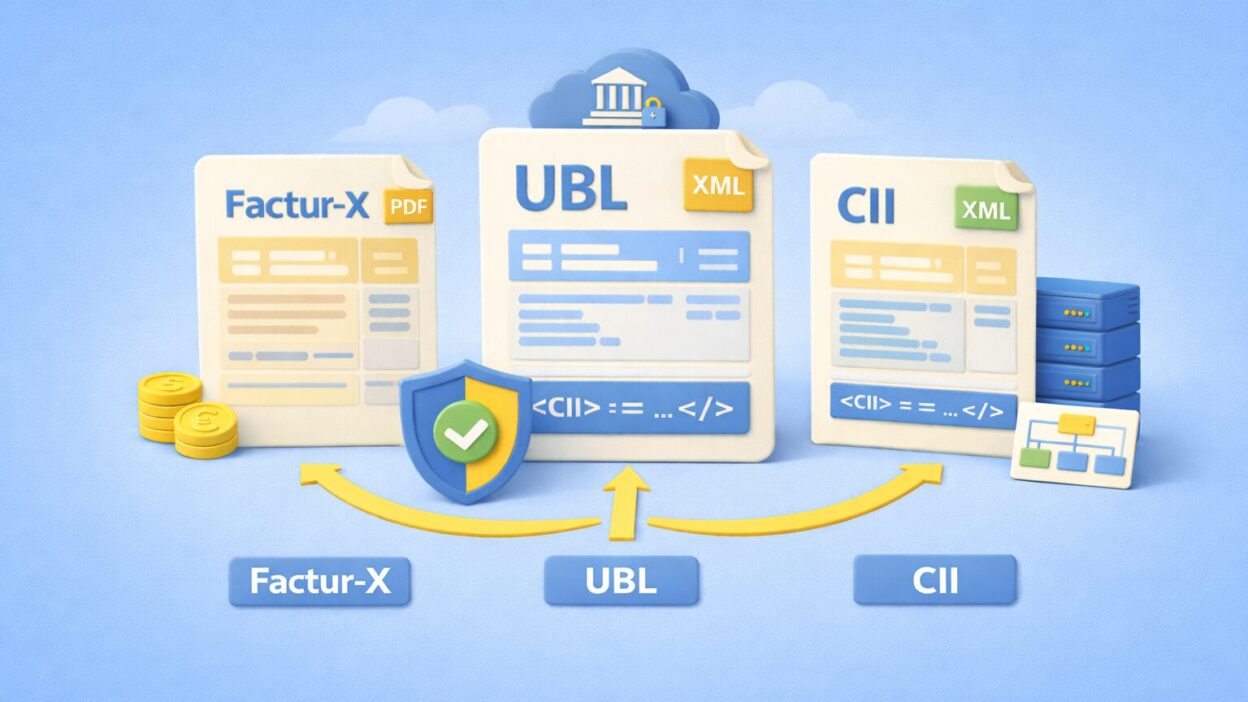
Gone are the days of PDF sent by email which, while it was long the norm, will no longer meet regulatory requirements. The new paradigm is built on structured formats, capable of being processed automatically by information systems, invoicing platforms, and the Public Invoicing Portal (PPF). In France, three formats are at the center of this system: Factur-X, UBL, and CII. Each presents distinct characteristics, suited to different levels of digital maturity, invoice volumes, and information systems.
This expert article, designed by Weproc, will guide you through the specifics of Factur-X, UBL, and CII. We will explore their advantages, their constraints, and their preferred usage contexts, to help you choose the most relevant format for your company. The objective is not to find the “best” format, but the one that will align perfectly with your organization and your automation ambitions.
⏱️ The Essentials in 2 Minutes
- Three official formats are accepted for electronic invoicing in France: Factur-X (hybrid), UBL (fully structured XML), and CII (fully structured XML).
- Simple PDF sent by email no longer complies with the 2026 reform, as the system shifts from document exchange to mandatory structured data exchange via approved platforms.
- The choice of ideal format depends crucially on your company’s digital maturity, your invoice volumes, your existing tools (ERP, accounting software), and your objectives for automating Procure-to-Pay processes.
The Electronic Invoicing Reform 2026-2027: A Major Change
The electronic invoicing reform, established by Article 26 of the 2022 supplementary budget law, represents an unprecedented evolution in the management of financial and administrative flows for companies in France. The obligation will roll out progressively, discover the electronic invoicing calendar:
- September 2026: Obligation to issue electronic invoices for large companies and mid-market enterprises. Obligation to receive for all companies.
- September 2027: Obligation to issue electronic invoices for SMEs and micro-enterprises.
The objective of this reform goes well beyond simple dematerialization. It is a strategic initiative by the State to modernize tax and commercial relations. The main objectives are:
- Fighting VAT fraud: By structuring data and transmitting it in real-time to the tax administration, the reform enables better fraud detection.
- Pre-filling VAT returns: Thanks to the data collected, the administration will be able to provide pre-filled VAT returns, simplifying the task for companies.
- Process automation for companies: Standardization of formats facilitates automatic integration of invoices into information systems, reducing manual entries, errors, and processing delays.
- Improvement of economic knowledge: The State will have near real-time visibility of economic activity.
To achieve these objectives, the reform is not limited to a single format, but allows the coexistence of multiple structured formats, all based on a common foundation: the European standard EN 16931. This standard defines the semantic model of the electronic invoice at the European level, ensuring that, regardless of the technical format chosen, the essential and mandatory information of the invoice is present and interpretable. This pragmatic approach makes it possible to adapt the transition to the different digital maturity levels of companies, from SMEs to large international groups.
Understanding this multi-format logic is essential. It is not about finding a format “better” than others, but about choosing the one that best matches your company’s organization, its existing tools, and its exchange flows with its commercial partners.
The Three Electronic Invoice Formats Authorized in France
As part of the electronic invoicing reform, France has opted for a flexible approach by accepting three electronic invoice formats. This choice recognizes the diversity of companies and their information systems. These formats, Factur-X, UBL, and CII, are all compliant with the European standard EN 16931 and recognized by the tax administration for transmission via the Public Invoicing Portal (PPF) or an Approved Platform (PA).
Factur-X: The Balance Between Readability and Structured Data
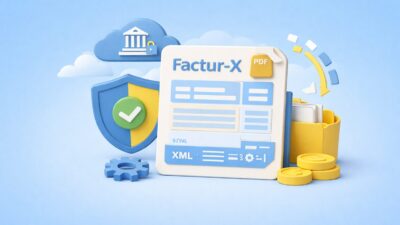
The Factur-X format is often presented as the most accessible and balanced of the three authorized formats. It is a hybrid format, which means it combines two elements within the same file:
- A PDF document readable by humans: This is the invoice as we know it, with its layout, logos, and all the visual information that teams are used to viewing.
- A structured data file (XML) embedded in the PDF: This XML file contains all the invoice data in a standardized and machine-readable form.
This dual advantage makes Factur-X particularly interesting. It facilitates human reading without requiring specific tools, while enabling automated processing via XML data extraction. For SMEs and mid-market enterprises, Factur-X offers a smooth transition to electronic invoicing. Teams can continue to view invoices as standard documents, while systems can begin to leverage structured data to automate accounting and financial processes.
Regulatory compliance is ensured by the embedded XML file, which complies with the EN 16931 standard and enables transmission of mandatory information to the Public Invoicing Portal. Factur-X is therefore an excellent entry point for companies that wish to comply with the reform without immediately disrupting their habits or tools.
UBL (Universal Business Language): The Standard for Automation
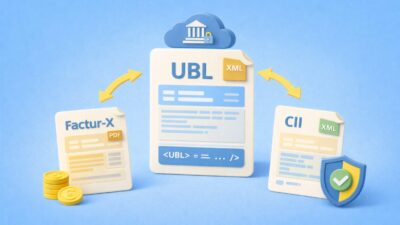
UBL, an acronym for Universal Business Language, is a radically different format from Factur-X. It is a 100% structured XML format, designed and intended to be processed automatically end-to-end by information systems, with no visual support intended for direct human reading.
This international format is based on a standardized data model, where each piece of invoice information (identifiers, references, product lines, amounts, VAT, payment terms) is integrated into a precise XML tag. This fine and unambiguous structuring makes UBL invoices particularly suited to automating controls, reconciling invoice/order, and accounting integration without re-entry.
UBL is the preferred choice of companies with a high level of digital maturity, particularly those equipped with a robust ERP (Enterprise Resource Planning) or using EDI (Electronic Data Interchange) solutions. It allows you to fully leverage the automation capabilities of systems and is widely used internationally for standardized commercial exchanges.
On the other hand, UBL is not directly readable by a human. A raw UBL file appears as long coded text, requiring software capable of transforming it into an intelligible visual rendering. Technical requirements are therefore greater, both for issuing and receiving, requiring suitable tools and precise, well-structured data repositories. The UBL format is a robust and high-performance solution for large-scale flows and highly automated processes.
CII (Cross Industry Invoice): The Standard for Complex Exchanges
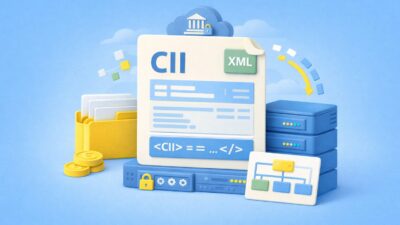
The CII format, or Cross Industry Invoice, is, like UBL, a 100% structured XML format. It aligns with UN/CEFACT (United Nations Centre for Trade Facilitation and Electronic Business) standards and is also compliant with the European standard EN 16931. CII is designed for automated and standardized exchanges between information systems, with a particular focus on international interoperability and robustness.
The philosophy of CII is one of strict compliance with international standards. It prioritizes data precision and normalization of exchanges, which makes it particularly suitable for large organizations, international groups, and complex environments where flows are massive and multi-ERP contexts.
CII is very rigorous in its XML structure. Each piece of information must be positioned in a precise tag, according to a strict data model. This rigor ensures uniform interpretation by systems, but leaves very little room for approximations or data errors. Missing or poorly structured data can result in outright rejection of the invoice, which requires governance of data and very precise initial configurations.
Like UBL, CII is not directly readable by a human. It requires tools capable of generating a visual rendering from XML. It is used where data reliability takes precedence over immediate readability, and where interoperability with various partners or international subsidiaries is a strong requirement. CII is a format for companies that operate on a large scale and have already industrialized their invoicing processes.
Comparison table: Which format for which business?
Choosing an electronic invoice format is a decision that must be carefully considered, as it directly impacts your company’s ability to integrate into the new electronic invoicing system. The three formats authorized in France – Factur-X, UBL, and CII – while all compliant with the EN 16931 standard, present significant differences in terms of usage, complexity, and benefits. Here is a detailed comparison table to help you understand:
| Criterion | Factur-X | UBL (Universal Business Language) | CII (Cross Industry Invoice) |
|---|---|---|---|
| Format type | Hybrid (visual PDF + embedded XML) | 100% structured (XML) | 100% structured (XML) |
| Human readability | Yes (via PDF) | No (requires a tool for visual rendering) | No (requires a tool for visual rendering) |
| Automated processing | Yes (via embedded XML) | Yes (designed natively for this) | Yes (designed natively for this) |
| EN 16931 compliance | Yes | Yes | Yes |
| Ease of implementation | ⭐⭐⭐⭐☆ (Smooth transition) | ⭐⭐☆☆☆ (Requires robust IT) | ⭐⭐☆☆☆ (Very prescriptive, complex) |
| IT system maturity required | Low to intermediate | High (ERP, EDI) | Very high (multi-ERP, international) |
| SME/ETI suitability | ⭐⭐⭐⭐☆ (Ideal for starting) | ⭐⭐☆☆☆ (If strong digitalization) | ⭐☆☆☆☆ (Rarely relevant alone) |
| Suitability for large accounts/advanced ETI | ⭐⭐⭐☆☆ (Possible for certain flows) | ⭐⭐⭐⭐☆ (Standard for automation) | ⭐⭐⭐⭐⭐ (High volumes, interoperability) |
| Invoice volumes | Medium | High | Very high, industrial |
| International interoperability | Good (via EN 16931 standard) | Very high (international standard) | Very high (UN/CEFACT standard) |
| Primary use case | Progressive transition, supplier heterogeneity, need for readability. | Advanced automation, ERP/EDI integration, P2P process optimization. | Regulated environments, complex and international flows, multi-ERP systems. |
This table highlights that Factur-X is a compromise format, ideal for SMEs and ETIs seeking a smooth transition. Its human readability minimizes resistance to change and allows maintaining visual comfort, while integrating the structured data necessary for compliance. It represents an excellent entry point for starting electronic invoicing.
Conversely, UBL and CII are formats designed for advanced automation. They require higher information system maturity and are primarily aimed at ETIs and large accounts that process high volumes of invoices and whose processes are already highly industrialized. UBL is a widely adopted international standard, while CII is often preferred for multi-entity contexts or with very strong normative requirements, particularly internationally.
The key to choice does not lie in finding the “best” format in absolute terms, but in identifying the format most suited to your company’s reality: its size, digital maturity, supplier heterogeneity, automation ambitions, and existing tooling.
Why PDF by email is no longer sufficient in 2026
For many years, PDF sent by email has been the most common and simplest digital solution for exchanging invoices. Universal, easy to create and view, it seemed to meet business needs. However, with the entry into force of the electronic invoicing reform in 2026, this mode of operation will no longer be considered compliant.
A PDF by email is not an electronic invoice compliant with the reform
The distinction is fundamental: a PDF is a digital document, but a simple PDF sent by email does not constitute a compliant electronic invoice under the new regulations. The reasons are multiple:
- Absence of standardized structured data: A standard PDF is an image, not structured data. Its information is not natively exploitable automatically by systems without recourse to costly and sometimes imprecise technologies like OCR (optical character recognition).
- Non-approved transmission channel: Email is a free and unsecured communication channel. The reform requires invoices to transit through Approved Platforms (PA) or the Public Invoicing Portal (PPF), guaranteeing traceability and integrity of flows.
- Impossibility of transmitting tax data: The system aims to collect data for the tax administration. A simple PDF offers no mechanism to extract and transmit this data in a standardized and reliable manner.
The fundamental change of the reform lies in the shift from a “document exchange” to a “exchange of structured and certified data”. It is this data – identifiers, amounts, VAT, invoice statuses – that enables fraud prevention, pre-filling of tax returns, and process automation for businesses.
The defined role of PDF in Factur-X
It is important to note that the reform does not sound the death knell for PDF itself. It ends its autonomous and unstructured use. In the case of the Factur-X format, the PDF remains present, but it is enriched:
- It integrates a structured XML file that carries regulatory value and enables automation.
- It is transmitted via an approved platform, thus fitting into the secured and traced circuit.
The PDF then becomes an enhanced visual support, with the XML file being the true heart of the electronic invoice. Continuing to use PDFs by email after 2026 will expose companies to risks of regulatory non-compliance, financial penalties, loss of traceability, and difficulties in transmitting their data to the tax administration. The transition to approved formats and channels is therefore not only an obligation, but also an opportunity to optimize and secure invoicing processes.
Formats and ecosystem: The role of the PPF and Approved Platforms (PA)
Choosing an electronic invoice format (Factur-X, UBL, CII) is only part of the equation. To be fully compliant with the 2026-2027 reform, it is imperative to understand the transmission ecosystem in which these formats operate. This ecosystem is built on the Public Invoicing Portal (PPF) and Approved Platforms (PA), formerly called Dematerialization Partner Platforms (PDP).
The Public Invoicing Portal (PPF): The state aggregator
The PPF, managed by the state, will not be a direct deposit point for B2B invoices for businesses. Its role is far more strategic and centralized:
- Aggregator of invoicing data: It consolidates data transmitted by Approved Platforms, whether from electronic invoices or from e-reporting (transmission of B2C transaction data and B2B payments).
- Business directory: It maintains an up-to-date directory of companies and their respective Approved Platforms, allowing correct routing of invoices.
- Gateway to DGFIP: It transmits collected data to the General Directorate of Public Finances (DGFIP) for pre-filling VAT declarations and fraud prevention.
The PPF is therefore the orchestrator of tax data circulation, ensuring visibility for the administration.
Approved Platforms (PA): Trusted intermediaries
Each company must mandatorily choose one or more Approved Platforms to manage its electronic invoicing flows. PAs are private actors, registered with the tax administration, who play a pivotal role:
- Issuance of electronic invoices: They allow issuing companies to deposit their invoices in a compliant format (Factur-X, UBL, CII).
- Reception of electronic invoices: They receive invoices from suppliers and make them available to the recipient company.
- Format control and conversion: They verify the compliance of invoice format and data. If needed, they can perform conversions between formats (for example, from UBL to Factur-X if the recipient prefers).
- Data transmission to the state: They extract mandatory data from invoices and transmit it to the PPF, as well as e-reporting data.
PAs are the true operators of invoice exchanges between companies.
The inseparable triptych: Format, Platform, Transmission
It is crucial to understand that the authorized invoice formats (Factur-X, UBL, CII) have value only if they operate within this approved transmission circuit. A technically perfect file but sent by email will not be compliant. Compliance is based on an inseparable triptych:
1. Standardized Format
Factur-X, UBL or CII
2. Approved Platform (PA)
Issuance and Reception
3. Data Transmission
To the PPF and then to DGFIP
The transmission scheme is as follows: the issuing company deposits its electronic invoice on its PA → the PA checks and transmits the invoice to the recipient company’s PA → in parallel, invoicing and e-reporting data are transmitted to the PPF, which relays them to DGFIP. Invoice circulation is orchestrated by PAs, while data circulation is orchestrated by the PPF.
Choosing the right format is therefore also about choosing an Approved Platform capable of managing that format, ensuring its compliance, and integrating seamlessly into the broader ecosystem. Interoperability between different PAs and the PPF is a fundamental pillar of the success of this reform.
How to Choose the Ideal Format for Your Business?
Choosing an electronic invoice format is a decision that goes far beyond simple regulatory requirements. It is a strategic approach that must be aligned with your company’s digital maturity, transaction volumes, existing tools, and process optimization objectives. Here are the key steps and criteria to consider to make the right choice.
Assess Digital Maturity and Invoice Volumes
The first step is to conduct an internal audit of your current practices and technical environment:
- Mapping current formats (outbound and inbound): What invoice formats do you currently use to send (PDF, paper, EDI, customer portals) and what formats do you receive from suppliers (PDF, paper, supplier portals)? This analysis will identify gaps relative to regulatory formats and anticipate necessary adjustments.
- Assessment of existing tools: What are your information systems? Do you have an ERP (SAP, Sage, Oracle, etc.), accounting software (Cegid, EBP), a procurement management tool (P2P), or an EDI solution? The ability of these tools to generate or interpret structured formats (XML) is a determining factor. A recent and well-configured ERP will be better equipped to handle formats like UBL or CII than simpler accounting software.
- Analysis of B2B invoice volumes processed: What is the average volume of invoices you issue and receive each month? For low volumes, Factur-X may be a sufficient solution. For massive flows, full automation provided by UBL or CII becomes essential to avoid operational overload.
- Consider diversity of partners (suppliers, customers): Do you primarily work with large, already highly digitalized groups, or with numerous SMEs and micro enterprises? If your partners are diverse, a more flexible format like Factur-X could facilitate general adoption. If your exchanges are mainly with actors already familiar with EDI or XML, UBL or CII will be more suitable.
Anticipate Integration into Procure-to-Pay (P2P) Processes
The format choice must be part of a broader vision for optimizing your Procure-to-Pay (P2P) chain, from order to payment. Electronic invoicing is a unique opportunity to automate and strengthen this chain:
- Define automation needs: What are your automation ambitions? Do you want automatic order/invoice matching, instant consistency checks, reduced disputes, or direct accounting integration? 100% XML formats (UBL, CII) are inherently more efficient for these objectives.
- Importance of upstream data structuring: Regardless of the format chosen, the quality of your upstream data (supplier references, article codes, payment terms, VAT rules) is crucial. Poorly structured data will generate rejections, even with the best format. UBL and CII formats are less tolerant of approximation and require great rigor.
- Link format choice to P2P chain robustness: In a mature P2P process, the invoice is no longer an isolated document, but a data stream that integrates naturally. Structured formats enable better traceability, more efficient dispute management, and more precise financial management. For example, integrating CII into an advanced P2P can transform the invoice into automatic confirmation of an already validated commitment, reducing manual controls.
- Impact on traceability, disputes, and financial management: Fully structured formats strengthen the information chain, reduce error and dispute risks, and offer better visibility over commitments and cash flow. A good format choice contributes to better operational performance and optimized financial management.

Recommendations by Company Profile
Based on these evaluations, here are general recommendations:
- For SMEs and mid-market companies with progressive digital maturity: Factur-X
This hybrid format is ideal for a smooth transition. It offers the readability of a PDF, reassuring for teams, while incorporating the XML data necessary for compliance. It is an excellent starting point for becoming familiar with electronic invoicing without disrupting existing operations. It is particularly suitable for companies with medium invoice volumes and heterogeneous partners. - For mid-market and large accounts with existing ERP and advanced automation objectives: UBL
If your company is already well-equipped (robust ERP, structured P2P processes) and processes high invoice volumes, UBL is a pertinent choice. This 100% XML format enables maximum automation, seamless system integration, and significant reduction in input errors. It is suited for companies aiming at complete industrialization of their invoicing flows. - For large groups, international contexts and complex IT systems: CII
CII is the most normative and demanding format. It is recommended for organizations with international subsidiaries, very complex information systems (multi-ERP) or high normative requirements for data quality and traceability. Its rigor ensures maximum interoperability in highly industrialized environments where flows are mostly machine-to-machine.
Do not forget that the choice can be dual: you can for example emit in Factur-X to your small suppliers/customers, and receive in UBL or CII from your large partners. The important thing is that your Approved Platform can manage this diversity.
Anticipate Now: Best Practices for 2026
The electronic invoicing requirement may seem distant for SMEs and micro enterprises, but for large companies and mid-market firms, the September 2026 deadline for reception and issuance is approaching rapidly. Anticipating is not merely a matter of compliance; it is a strategic approach to secure your flows, optimize cash flow, and strengthen supplier relationships. Waiting until the last minute risks operational and financial blockages. Here are best practices to adopt immediately.
1. Structure business data before choosing technical format
The format is only the container; the quality of the data it carries is paramount. Even before worrying about the type of XML, ensure your business data is reliable and consistent:
- Consistency of information: Verify your supplier, customer, article, and cost center references.
- Reliability of mandatory information: Ensure all legal information is systematically present and accurate (VAT number, address, etc.).
- Attachment to orders and contracts: Good structure enables automatic and precise matching.
Poorly structured data, even in a compliant format, will generate rejections and disputes. It is the foundation of all successful automation.
2. Test receipt of all three formats (Factur-X, UBL, CII) as priority
The obligation to receive electronic invoices concerns all companies as of September 2026. It is therefore crucial to ensure you are capable of:
- Receiving and correctly interpreting all three authorized formats.
- Automatically integrating these invoices into your systems (accounting, procurement).
- Managing exceptions and non-compliant invoices without blocking your processes.
Reception is often the most underestimated friction point. Launch tests with pilot suppliers to validate the entire supplier invoice reception chain.
3. Choose an Approved Platform (PA) suited to volumes and specificities
The Approved Platform will be your key contact in the new system. Do not choose it lightly. Consider the following criteria:
- Invoice volumes: The PA must be capable of managing your issuance and reception volumes.
- Complexity of your procurement/financial processes: Look for a PA offering advanced features (matching, dispute management, validation workflows) if your needs are complex.
- Integration with your existing tools: Ensure the PA offers connectors or APIs to integrate with your ERP, accounting software, or P2P solution (like Weproc PA Connect).
- Support and assistance: The quality of customer service and support will be essential during and after the transition.
4. Gradually involve internal teams (Procurement, Finance, IT) and suppliers
The reform is not only a technical project; it is a company transformation project. To avoid resistance to change:
- Raise team awareness: Inform employees in the Procurement, Accounting, Finance, and IT departments about the reform’s stakes.
- Train your teams: Provide training for the use of new tools and processes.
- Communicate with your suppliers: Explain the upcoming changes, the format you will prioritize, and transmission methods. Anticipate specific cases (small suppliers less digitalized) and learn to support your suppliers.
5. Transform the regulatory constraint into an optimization opportunity
Far beyond compliance, electronic invoicing is a unique opportunity to modernize your operations. Companies that anticipate and deploy the reform with a strategic vision reap concrete benefits:
- Reduction of invoicing disputes: Structured data and automated controls reduce errors and ambiguities.
- Better visibility on commitments and cash flow: More precise management through reliable, real-time data.
- Automation of controls and validations: Time and productivity gains for teams.
- Shorter processing times: Acceleration of the Procure-to-Pay cycle and payments.
Anticipating electronic invoicing means building a resilient and efficient system capable of handling upcoming formats, rules, and volumes. It is transforming an obligation into a powerful lever for efficiency and competitiveness.
Electronic Invoice Format: A Strategic Decision for the Company
The arrival of mandatory electronic invoicing in 2026-2027 is far more than a simple technical update or a new administrative constraint. It is a silent revolution redefining B2B commercial exchanges and placing data at the heart of financial processes. In this context, choosing an electronic invoice format is not a detail, but a fundamental strategic decision for your company’s future.
An appropriate format (whether Factur-X for smooth transition, UBL for advanced automation, or CII for international interoperability and complex flows) guarantees the quality of exchanged data. This quality will then determine the fluidity of your processes, the reliability of your controls, and ultimately your ability to effectively manage your financial flows.
A poor choice, or insufficient anticipation, can have significant consequences: invoice rejections, supplier disputes, payment delays, operational overload for teams, and fiscal non-compliance risks. Conversely, a proactive approach and an informed choice will transform this regulatory obligation into a unique opportunity for digital transformation to optimize supplier management and ensure compliance. Companies addressing the issue now with a strategic vision can expect tangible benefits:
- Improvement of operational performance: Automation of processing, reduction of manual entries, and decreased errors free up time for teams to focus on higher-value tasks.
- Strengthening of financial data: Structured and standardized invoices guarantee better data integrity, essential for accounting, reporting, and financial analyses.
- Optimization of financial management: Real-time visibility over invoice flows and commitments enables stricter cash control, better payment deadline management, and valuable support for strategic decision-making.
- Reinforcement of commercial relationships: Smooth processes without disputes help improve satisfaction of customers and suppliers.
At Weproc, we are convinced that electronic invoicing is a powerful lever to industrialize and secure your Procure-to-Pay processes. Our Weproc PA Connect solution is designed to support your company through this transition, offering you an approved platform capable of managing all authorized formats (Factur-X, UBL, CII) and integrating seamlessly with your existing systems.
The format is therefore not a technical detail to relegate to IT teams. It is a decision that engages the organization, tools, and performance of your company for years to come. By equipping yourself with the right format and right solutions, you do not merely comply with the law: you prepare your company for a more digital, more efficient, and more resilient future.