
From 2026 onwards, mandatory electronic invoicing will profoundly transform financial flow management for all French companies. This major reform, governed by the General Directorate of Public Finances (DGFIP), introduces an unprecedented technical and regulatory architecture, aiming to secure transactions, streamline exchanges and optimize VAT control.
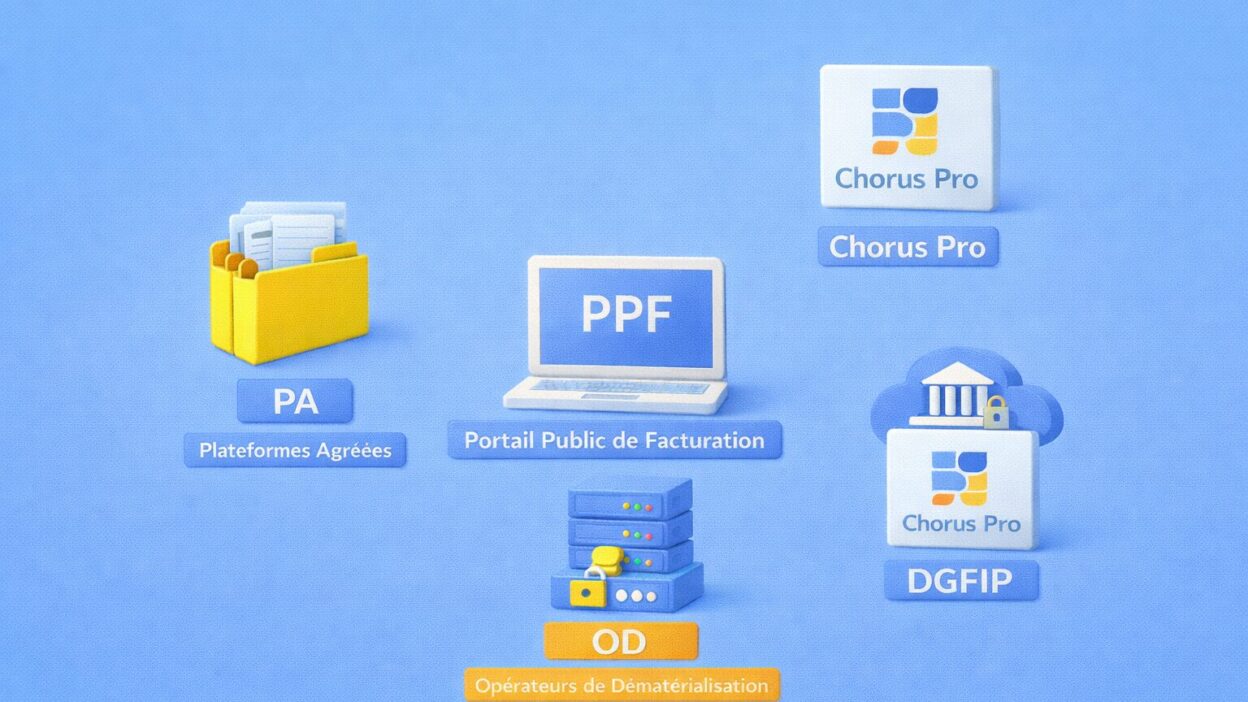
At the heart of this new system operate several key actors: the Public Invoicing Portal (PPF), Approved Platforms (AP), Digitalization Operators (DO) and Chorus Pro, which retains a specific role. However, the proliferation of acronyms, the rapid evolution of terminology and the apparent complexity of interactions often create legitimate confusion within organizations.
The objective of this article is to demystify this architecture. We will, in a pedagogical and concrete manner, detail the role of each entity, explain how invoices actually circulate and how these systems integrate into your daily tools. Understanding these mechanisms is fundamental to confidently preparing for the reform and making it a true performance lever.
⏱️ The Essential in 2 minutes
- The distinction between the Public Invoicing Portal (PPF) and Approved Platforms (AP, formerly PDP) is fundamental: the PPF is a public data hub, while Approved Platforms are private operational actors who actually transmit invoices.
- Approved Platforms (AP) are the operational heart of the reform. They ensure the issuance, reception and compliance of electronic invoices, acting as mandatory intermediaries between companies.
- Digitalization Operators (DO) are essential complements. They integrate invoice flows into business processes (Procure-to-Pay, accounting), ensuring operational efficiency and financial control, beyond simple regulatory compliance.
Understanding Electronic Invoicing 2026 Architecture
The electronic invoicing reform, whose obligation will gradually extend to all companies subject to VAT between 2026 and 2027, represents one of the most significant changes in financial and administrative management in decades. Its objective is clear: simplify and automate reporting obligations, combat VAT fraud and modernize B2B (Business to Business) and B2G (Business to Government) commercial exchanges.
Yet, despite extensive communication, the overall vision of the architecture remains unclear for many organizations. Confusion is heightened by the fact that the system is complex by nature, involving numerous actors whose roles intersect and influence each other.
To navigate this complexity, it is crucial to master the key acronyms that punctuate the reform:
- PPF: Public Invoicing Portal, the central state platform.
- AP: Approved Platform, the private actor approved for electronic invoice exchange (formerly PDP).
- DO: Digitalization Operator, a technological actor complementary to AP, often your ERP or business solution.
- DGFIP: General Directorate of Public Finances, the tax authority that drives the reform.
- Chorus Pro: The historical platform for invoice exchanges with the public sector (B2G).
The primary objective here is to clarify their respective roles, their interactions and to understand how they fit into the lifecycle of an invoice, from its issuance to its accounting integration, through transmission to the tax authority.
The Usual Sources of Confusion
The perception of complex electronic invoicing architecture in France is not always linked to inherent complexity, but rather to a set of historical and terminological factors that have muddied the waters.
The first source of confusion is the multiplication of acronyms. As mentioned, PPF, PDP, AP, DO, e-invoicing, e-reporting, DGFIP… These terms are omnipresent, often used without clear definition of their exact scope. As a result, companies struggle to distinguish technical tools from regulatory platforms or tax authorities, even though they operate at totally different levels.
The evolution from “Partner Digitalization Platform” (PDP) status to “Approved Platform” (AP) also created confusion. For several years, the market prepared around PDPs, before the administration evolved the terms and requirements. Although the underlying role remains similar, this change required a mental readjustment that may have disturbed companies’ understanding of what was truly stable or changing.
The legacy of Chorus Pro is another major component of this confusion. Being the unique and mandatory platform for B2G invoicing (Business to Government) since 2020, Chorus Pro is sometimes incorrectly perceived as the future generalized model for B2B. Yet, as we shall see, Chorus Pro retains a specific role and is absolutely not the central architecture for electronic invoicing between private companies.
Finally, a crucial distinction is rarely explained: that between tools, roles and obligations. A platform is not a tax authority, invoicing software is not an Approved Platform, and transmitting an invoice is not equivalent to transmitting tax data. These nuances are essential for any company wishing to approach the reform with a relevant and compliant tooling strategy. Ignoring these distinctions can lead to ineffective investments or compliance risks.
The Journey of an Electronic Invoice: Overview
To properly understand the roles of each actor, it is essential to visualize the path of an electronic invoice within the new system. Unlike current practices where an invoice often transits directly from a supplier to a customer by email or via simple PDF exchange, the 2026 reform imposes a standardized and regulated process.
The Principle of Non-Direct Transmission
The first fundamental break with past practices is the abandonment of direct invoice transmission between companies. In the new model, an electronic invoice never goes directly from the supplier to its customer. It must obligatorily pass through an Approved Platform (AP), which acts as a trusted third party and regulated intermediary.
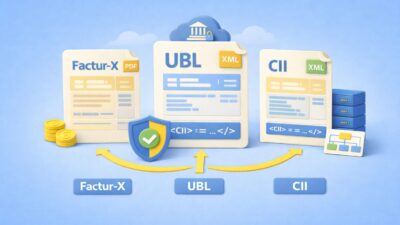
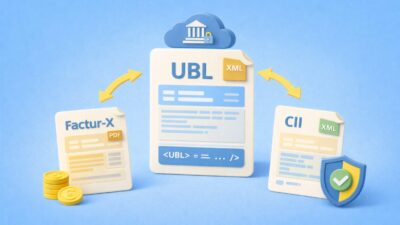
This principle is the cornerstone of the reform. It not only guarantees the authenticity and integrity of invoices, but also their compliance with required technical formats (Factur-X, UBL, CII) and the automatic transmission of essential tax data to the administration, via the Public Invoicing Portal (PPF).
The Simplified Journey of a B2B Invoice
Here is the logical and mandatory pathway of a B2B electronic invoice:
- The issuing company (Supplier) generates a compliant electronic invoice (Factur-X, UBL or CII) via its ERP, invoicing software or Digitalization Operator (DO).
- This invoice is then transmitted to its own Issuing Approved Platform (Issuing AP). The AP verifies the format, data structure and regulatory compliance.
- The issuing AP performs two simultaneous actions:
- It transmits the electronic invoice to the customer, via the customer’s Receiving Approved Platform (Receiving AP). This AP is identified via the centralized PPF directory.
- It extracts and transmits billing data (net amount, VAT, identifiers, date, etc.) to the Public Invoicing Portal (PPF).
- The PPF centralizes this billing data (and e-reporting), aggregates it and transmits it to DGFIP. This information is used for tax control, real-time monitoring of collected/deductible VAT and pre-filling of tax returns.
- The receiving company (Customer) receives the invoice via its receiving AP, then integrates it into its own accounting, financial and Procure-to-Pay processes (via a DO, for example).
SIMPLIFIED DIAGRAM OF B2B ELECTRONIC INVOICING FLOW
Issuing Company
(ERP, Invoicing Software, DO)
➡️
(Issuance)
Issuing Approved Platform (AP)
(Controls, Processing)
➡️
(Distribution)
Public Invoicing Portal (PPF)
(Directory, Tax Data Collection)
⬇️
(To DGFIP)
DGFIP
(Control, Pre-filling)
⬅️
(Reception)
Receiving Approved Platform (AP)
(Validation, Availability)
⬅️
(Integration)
Receiving Company
(DO, ERP, Accounting)
This unique circuit guarantees complete traceability and regulatory compliance at each step. It highlights that the reform does not establish a single “super-tool”, but a coordinated ecosystem where each actor assumes precise responsibility for the security and standardization of electronic invoicing flows.
The Public E-Invoicing Portal (PPF): Official Hub
The Public E-Invoicing Portal (PPF) is undoubtedly the most frequently misunderstood actor in the electronic invoicing architecture. As a public infrastructure led by the State, it occupies a central position, but its role is fundamentally different from that of a business tool that companies would use daily. It is neither management software nor a solution designed to replace existing ERPs or invoicing tools.
The PPF is first and foremost a point of convergence and regulation for the system. It ensures crucial institutional and technical functions, serving the tax authority’s fiscal objectives and the success of the reform. It is the invisible orchestrator that guarantees the coherence of the entire system.
The PPF’s Specific Roles
The PPF primarily ensures three structuring functions, essential to the proper functioning of electronic invoicing and e-reporting:
- The Reference Directory of APs and Enterprises: The PPF maintains a centralized and constantly updated directory. This directory is vital because it makes it possible to identify, for each enterprise subject to VAT, the Approved Platform(s) (AP) it has chosen to emit and receive its electronic invoices. When an issuing AP must send an invoice to a client, it consults this directory to know which receiving AP it should address it to. Without this directory, invoice routing would be impossible. The PPF also manages the registration of enterprises and their APs, ensuring a dynamic and reliable mapping of the ecosystem.
- The Centralization of E-Invoicing and E-Reporting Data: This is one of the most important roles. When invoices transit between issuing and receiving Approved Platforms, essential invoicing data (party identifiers, amounts exclusive of tax, VAT amounts by rate, dates, etc.) are transmitted to the PPF. The PPF does not store invoices themselves as business documents, but centralizes only the data necessary for tax monitoring. This “data reporting” process is crucial for the Tax Authority. Furthermore, for operations not covered by electronic invoicing (B2C, transactions with foreign countries), the PPF also collects e-reporting data, necessary for VAT declaration pre-filling and tax control.
- Data Transmission to the Tax Authority: The PPF acts as the official and sole relay between all private platforms (APs) and the tax administration. It consolidates invoicing and e-reporting data collected and transmits them to the Tax Authority. This allows the administration to:
- Perform nearly real-time VAT control (cross-check between collected VAT and deductible VAT).
- Pre-fill enterprises’ VAT declarations.
- More effectively combat tax fraud through increased visibility on commercial flows.
What the PPF is NOT
To dispel any ambiguity and avoid incorrect tooling strategies, it is crucial to understand what the PPF absolutely is not:
- ❌ The PPF is NOT a business tool to manage your invoices daily. It does not allow you to issue invoices, view them, validate them, or archive them for operational uses. It is a routing and data collection infrastructure, not management software.
- ❌ The PPF is NOT an invoicing platform. It does not replace your ERP, your accounting software, or your Procure-to-Pay solution. Enterprises do not connect directly to the PPF to send or receive invoices. That is the role of Approved Platforms.
- ❌ The PPF is NOT an Approved Platform (AP). It does not ensure the operational circulation of invoices between enterprises. Its role is to regulate, announce APs, and collect data for the Tax Authority.
In summary, the PPF is the public conductor of the system, guaranteeing the coherence and reliability of fiscal information exchanges. It in no way substitutes for enterprises’ operational tools or the services provided by Approved Platforms. This distinction is essential for developing a realistic and effective compliance strategy.
Approved Platforms (AP): The Operational Core
If the PPF is the official hub and the regulator, Approved Platforms (APs) are the true operational engine of electronic invoicing in France. Formerly referred to as Partner Dematerialization Platforms (PDP), APs are private actors, selected and approved by the tax administration, whose mission is to ensure the effective and secure circulation of electronic invoices between enterprises. They perform the majority of daily work on behalf of enterprises.
An AP is therefore much more than a simple technical service provider; it is an essential link in the compliance chain. Its approval by the State testifies to its ability to comply with strict requirements regarding security, data integrity, flow traceability, and technical resilience.
Key Functions of APs
Approved Platforms fulfill a series of crucial functions for enterprises and for the system as a whole:
- Issuance and Receipt of Electronic Invoices: This is the primary function. An AP allows the issuing enterprise to transmit its customer invoices and the receiving enterprise to receive them. They act as mandatory intermediaries, ensuring that invoice flows between two enterprises pass through the regulatory circuit. They handle the routing of invoices to the correct receiving AP by consulting the PPF directory.
- Format Compliance Control: APs are responsible for verifying that transmitted electronic invoices comply with accepted regulatory formats (Factur-X, UBL, or CII). This control is essential to guarantee interoperability and proper data exploitation by all parties, including the Tax Authority. They can also transform unstructured formats (such as image PDFs) into compliant electronic formats if the enterprise uses a Dematerialization Operator or if the AP itself offers these services.
- Data Transmission to the PPF: In parallel with invoice routing between enterprises, APs extract invoicing data (and e-reporting data if applicable) and transmit them to the PPF. This “data reporting” is the essential contribution of APs to information collection for the tax administration. They guarantee the accuracy and completeness of the data transmitted.
- Management of Invoice Lifecycle Statuses: APs track invoice statuses throughout their lifecycle (submitted, refused, collected, paid, etc.). They communicate these statuses to enterprises and the PPF. This status management is critical for traceability, dispute resolution, and internal financial process management, offering better visibility on invoice processing progress.
In summary, APs are the guarantors of invoice integrity, authenticity, and readability, and ensure complete flow traceability. Their role is to absorb technical and regulatory complexity to allow enterprises to focus on their activities.
AP vs Business Tool
It is important to clearly distinguish the Approved Platform from the enterprise’s internal ERP or invoicing software. An AP is not necessarily an ERP or a complete invoicing solution:
- The ERP or invoicing software is the enterprise’s business tool, where orders and deliveries are created and initial invoices are generated (often as raw data or PDF).
- The AP is the regulated intermediary that takes over from this business tool to transform the invoice into compliant electronic format, control it, transmit it to the client’s AP, and report data to the PPF.
An enterprise can therefore continue to use its usual ERP, provided it can interface with an AP. Some APs can also offer business tool functionalities, but this is not their primary or exclusive purpose. The fact that approval is granted by the State is a guarantee of compliance and reliability, making APs the true operational core that makes the electronic invoice reform concrete and functional.
Dematerialization Operators (DO): Essential Complement
In the electronic invoicing ecosystem, Dematerialization Operators (DOs) play an often underestimated but nonetheless essential role in operational efficiency for enterprises. While Approved Platforms (APs) guarantee regulatory compliance and invoice transmission to the PPF, DOs intervene upstream or downstream to ensure that enterprises’ business processes remain fluid, performant, and integrated.
A Dematerialization Operator is a technological actor that is not directly authorized to transmit fiscal data to the State via the PPF – that is the exclusive role of APs. The DO is also not subject to the specific regulatory approval required for APs. However, its expertise lies in the ability to structure, transform, and orchestrate invoice flows so they are fully exploitable by the enterprise’s finance, procurement, and accounting teams.
DOs often come from the world of ERPs and accounting software, invoicing solutions, Procure-to-Pay (P2P) platforms, or e-procurement and supplier management tools. Their common point is being closest to enterprises’ daily usage, bringing added value that goes well beyond simple compliance.
Role of DOs in Electronic Invoicing
DOs fill functional gaps that neither the PPF nor APs are designed to cover. Their key functions are as follows:
- Advanced Receipt and Centralization of Supplier Invoices: A DO goes beyond the simple “provision” of the invoice by the AP. It centralizes all received invoices, regardless of their origin channel (via AP, but also via email for non-subject entities, or even paper for residual cases), offering a single entry point and consolidated view to the enterprise.
- Business Controls and Internal Compliance: The DO applies much finer internal management rules than the purely fiscal controls performed by APs. It verifies information consistency (order numbers, receipt references, payment terms), compliance with procurement policies, and detects business anomalies (duplicates, incorrect prices).
- Invoice / Order / Receipt Reconciliation: This is one of the most valued functions of DOs. They automate the reconciliation between received invoices, purchase orders, and receipt notes. This feature drastically reduces manual interventions, accelerates processing, and minimizes errors, ensuring that only goods and services actually ordered and received are paid.
- Management of Validation Workflows: DOs orchestrate complex validation circuits, routing invoices to the appropriate stakeholders (managers, project leads, technical services) for approval before payment. These workflows are customizable based on expense nature, thresholds, and enterprise organization.
- Accounting and Analytical Integration: After validation, the DO prepares the invoice for automatic integration into the enterprise’s accounting system and ERP. It ensures correct accounting and analytical allocation, generates entries, and guarantees data integrity in financial systems.
- Procure-to-Pay and Spending Management: By aggregating all this data, the DO provides dashboards and reports allowing oversight of the entire Procure-to-Pay cycle (from purchase to payment), spending analysis, payment delay optimization, and identification of cost-saving opportunities.
The DO does not simply “pass through” an invoice; it inscribes it in a structured business process where operational performance, financial control, and security of internal processes are at stake.
Articulation of DO and AP
The distinction between DO and AP is functional and not competitive. They respond to complementary logics:
- The AP guarantees the regulatory compliance of the invoice (format, integrity, authenticity) and its transmission to the public ecosystem (PPF, Tax Authority). It ensures external interoperability.
- The DO guarantees the operational efficiency of the invoice within the enterprise (business integration, internal controls, workflows, oversight). It ensures internal exploitability.
Concretely, an AP without a DO can allow you to be compliant, but will expose you to compliant flows that are barely exploitable, requiring manual re-entry, partial controls, and low operational visibility. Conversely, a DO without an AP would allow you to handle your invoices well internally, but without guaranteeing their regulatory compliance and mandatory transmission to the PPF. It is precisely the intelligent articulation between these two types of actors that structures the target architecture of electronic invoicing.
Weproc, in this ecosystem, has historically developed its expertise as procurement software, with a robust platform focused on receipt, control, and orchestration of supplier invoices within the Procure-to-Pay framework. Given the reform’s stakes, Weproc has evolved its positioning toward a hybrid model, integrating Approved Platform status for invoice receipt, and offering connection capabilities of an AP for issuance via its clients’ existing business tools. This approach allows reconciling regulatory compliance and business efficiency without unnecessarily complicating the architecture for enterprises.
Why a DO Remains Essential, Even with an AP
The reform might suggest that an AP alone is sufficient for “conducting electronic invoicing.” In reality, compliance does not make a process efficient. Without a DO:
- Controls are limited to the fiscal framework, ignoring internal management rules specific to your enterprise.
- Business validation and approval workflows remain manual or disintegrated, generating delays and errors.
- Reconciliations between orders, deliveries, and invoices remain partial or manual, increasing fraud risk or payment errors.
- The invoice remains a “suffered” object rather than a “controlled” element of your financial management, making spending analysis and optimization difficult.
The DO is therefore the indispensable operational layer, the one that transforms a regulatory obligation into a controlled, fluid process, rich in exploitable data and value-creating for the enterprise. In the target architecture of electronic invoicing, the role of DOs is not secondary; it is the anchor point between the imposed standard and the reality of organizations, allowing extraction of the full potential of dematerialization.
Chorus Pro: A Specific B2G Role
Chorus Pro holds a distinct and well-established position in the French paperless processing landscape. It is familiar to most businesses with contracts involving the public sector. However, it is essential not to confuse it with the new B2B electronic invoicing system. This confusion is frequent and can lead to inadequate compliance strategies.
Chorus Pro: a platform dedicated to exchanges with the public sector
Chorus Pro is France’s unique national mandatory platform for B2G (Business to Government) electronic invoicing. Its deployment was progressive, making the transmission of electronic invoices to French public entities (State, territorial authorities, public institutions) mandatory for all companies since 2020.
Its role is clearly defined and circumscribed:
- Supplier invoice reception: Chorus Pro is the single point of entry for all invoices intended for the public sector.
- Compliance control: The platform ensures specific regulatory controls to B2G requirements (commitment number, recipient service, etc.).
- Transmission and status tracking: It manages invoice transmission to public entities and ensures monitoring of their processing (deposited, rejected, accepted, pending payment, etc.).
- Integration with administrative systems: Chorus Pro is designed to interface with the accounting and financial systems of public administrations.
Chorus Pro is therefore an operational business tool, fully integrated in the processes of businesses and administrations that collaborate together.
What Changes and What Does Not
An essential point to clarify is that the B2B electronic invoicing reform that will apply from 2026-2027 does not at all replace Chorus Pro. The two systems are distinct and coexist:
- What does not change:
- Chorus Pro remains the mandatory platform for all B2G invoicing.
- Businesses will continue to submit their invoices intended for the public sector via Chorus Pro.
- Rules specific to B2G remain independent of the new B2B system.
- What changes:
- The 2026-2027 reform introduces an entirely new system specifically dedicated to B2B exchanges, based on the PPF and Approved Platforms (PA).
- This B2B system also manages e-invoicing flows and e-reporting flows (transmission of transaction data not subject to e-invoicing).
- This new system is independent of Chorus Pro.
In other words, Chorus Pro maintains its historical scope and does not become the universal platform for electronic invoicing for all transactions.
Why Chorus Pro Is Not the B2B Foundation
Several reasons explain why Chorus Pro cannot serve as the basis for generalizing B2B electronic invoicing:
- B2G-specific design: Chorus Pro was specifically designed to meet the needs and constraints of exchanges between businesses and public administrations. Its features, controls, and architecture are not suited to the massive volumes and diversity of inter-business exchanges.
- Absence of e-reporting: Chorus Pro does not integrate e-reporting use cases, which are a major component of the B2B and B2C reform (transactions with individuals or foreign businesses).
- Centralized vs. distributed architecture: The B2B system is based on a distributed architecture, with multiple interoperable private Approved Platforms, and the PPF as the centralizing point for data. Chorus Pro is a unique centralized platform for B2G, without this multi-platform logic.
Confusing Chorus Pro and the 2026-2027 B2B system can lead to strategic errors: delays in preparation, choice of inappropriate tools, or the false impression of already being compliant with all obligations. It is essential to clearly distinguish these two worlds for a smooth and efficient transition.
Key takeaway: Chorus Pro = B2G electronic invoicing; 2026-2027 System = B2B electronic invoicing + E-reporting. The two coexist and businesses with public sector activities will need to manage both.
Summary of Roles: Who Does What?
To better visualize the architecture and responsibilities of each stakeholder in the new electronic invoicing system, the summary table below offers a synthetic and operational overview. It clarifies the main role, type of flow involved, concrete actions performed by each entity, and, equally important, what it does not do.
| Entity | Main role | Intervenes on which flows? | What it concretely does | What it does not do |
|---|---|---|---|---|
| DGFIP | Tax and regulatory authority | All (B2B, B2G, B2C, international) | Defines the legal and regulatory framework, processes collected fiscal data (VAT, e-reporting), drives tax control, pre-fills VAT returns. | Does not issue or receive invoices, does not directly interact with businesses for invoice circulation, is not a technical platform. |
| PPF (Public Invoicing Portal) | Public data hub and directory | B2B (e-invoicing), B2C and international (e-reporting) | Maintains directory of Approved Platforms (PA) and businesses, centralizes invoicing data (not invoices themselves), transmits this data to DGFIP. | Is not an invoice emission or reception platform, is not a business tool usable by businesses, does not perform business controls. |
| PA (Approved Platform) | Operational core of electronic invoicing | B2B (e-invoicing) and certain e-reporting functions | Emits and receives electronic invoices on behalf of businesses, performs technical and regulatory compliance checks, transmits data to PPF, manages invoice lifecycle statuses. | Does not replace ERP or accounting business tools, does not manage complex business processes of the company (e.g.: approval workflows). |
| OD (Digitization Operator) | Process integrator and optimizer | All (B2B, B2G, B2C), upstream or downstream of PA | Connects business tools to PA, centralizes and pre-processes invoices, ensures internal business controls, manages validation workflows, reconciles invoices with orders/receipts, integrates data into accounting and ERP systems. | Is not authorized to directly transmit invoicing or e-reporting data to PPF (must go through a PA), is not subject to specific PA certification. |
| Chorus Pro | Mandatory B2G platform | B2G only | Receives and processes invoices intended for the public sector, ensures status tracking for public entities. | Does not process B2B or B2C flows, does not manage e-reporting, does not substitute PPF or PA for private transactions. |
| ERP / Business Tool / e-procurement | User operational management tool | All (according to use) | Generates source data underlying invoices, receives and processes supplier invoices after passing through PA and OD, feeds business and accounting data flows. | Does not alone ensure regulatory compliance of electronic invoicing, does not directly connect to PPF. |
Integration of Stakeholders Into Your Finance & Procurement Tools
The electronic invoicing reform is not intended to replace your existing information systems, but to integrate with them. It restructures invoice and data flows around new key stakeholders. Understanding this integration is essential to avoid a purely technical vision and to align compliance strategy with the company’s business and financial objectives.
ERP and invoicing tools: the emission point
Your ERP (Enterprise Resource Planning) and invoicing software remain the heart of your customer invoice production. They generate the essential data: customer identifiers, descriptions of goods and services, prices, amounts excluding tax and VAT, etc.
Depending on their maturity level and equipment, these tools can:
- Directly produce an invoice in a compliant electronic format (Factur-X, UBL, CII). In this case, the ERP must then transmit this invoice to an Approved Platform (PA) so it ensures final checks and regulatory transmission.
- Transmit raw invoicing data to a PA which will handle generating the electronic format and performing all necessary checks.
In many environments, the ERP will not natively have all the features of a PA. Connection to an external PA then becomes the preferred solution for issuing compliant electronic invoices without costly and complex overhaul of the existing system. The important thing is that the ERP can communicate effectively with the chosen PA.
Accounting tools and Procure-to-Pay: the reception core
On the supplier invoices side (reception), accounting tools and, especially, Procure-to-Pay (P2P) solutions play a central role and are where the reform will have the most operational impact and value-added potential. These are the systems that:
- Receive electronic invoices via your reception PA.
- Exploit structured invoice data, enabling advanced process automation.
- Automate critical controls: coherence with orders and receipts, VAT validity, duplicate detection.
- Orchestrate internal validation workflows and prepare invoices for payment.
It is on this scope that data quality and process fluidity have the most impact on operational performance. A Procure-to-Pay solution well connected to a PA allows securing reception, making controls reliable, and accelerating payments, regardless of your suppliers’ emission capacity.
Separating Emission and Reception: A Strategic Choice
The reform does not require using a single tool for all your obligations. On the contrary, many companies adopt a strategic approach by separating systems for emission and reception:
- For emission: Use the existing ERP or business tool, connected to a PA for compliance and transmission. This minimizes impacts on existing sales and invoicing processes.
- For reception: Entrust orchestration of supplier invoices to a dedicated Procure-to-Pay solution, which can itself be a PA or interface with a PA. This approach allows strengthening control of purchase flows and spending, often larger and more complex.
This separation provides great flexibility and allows leveraging the strengths of each system, while ensuring regulatory compliance.
Strategic Vision for CFOs
For a Chief Financial Officer (CFO), the challenge is not simply adding technical components, but building a coherent, robust, and manageable architecture. This involves:
- Reliable business tools (ERP, CRM, etc.) for generating source data.
- Approved Platforms (PA) ensuring regulatory compliance, invoice and data integrity, and transmission to PPF.
- A Procure-to-Pay solution (OD) driving reception, business controls, workflows, and offering complete spending visibility.
In this integrated vision, electronic invoicing is not an isolated IT project, but a major strategic lever for financial and procurement management. It enables data reliability, improves tax compliance, optimizes internal processes, and strengthens overall company performance. It is an opportunity to transform a constraint into competitive advantage.
Anticipating the Reform: Strategy and Serenity
The electronic invoicing reform, with its tight timeline and profound implications, represents a major challenge but also a considerable opportunity for French businesses. It is not limited to a simple change in invoice format or last-minute technical connection. It is based on a precise and interconnected architecture, in which each stakeholder – DGFIP, the Public Invoicing Portal (PPF), Approved Platforms (PA), Digitization Operators (OD), business tools and Chorus Pro – plays a distinct and complementary role.
Failing to understand this distribution of roles and interactions between these different entities exposes businesses to significant risks. This can lead to inappropriate tool choices, to oversized investments in solutions that do not meet real needs, or, conversely, to incomplete systems that weaken regulatory compliance and increase the risk of sanctions. A clear and strategic understanding of the architecture is therefore the first step toward a successful transition.
Conversely, a lucid and thorough reading of this architecture allows structuring a realistic and efficient compliance trajectory, perfectly aligned with existing finance and procurement department processes. By precisely identifying who does what, where essential data flows and how emission and reception functions harmoniously articulate, businesses transform a regulatory obligation into a powerful lever for operational control and innovation.
This is the opportunity to rethink and optimize your entire Procure-to-Pay and Order-to-Cash value chain. By adopting a proactive and informed approach, you can not only guarantee your tax compliance, but also achieve significant efficiency gains, reduce administrative costs, improve visibility of your financial flows, and strengthen the security of your transactions.
Ultimately, a well-understood electronic invoicing architecture is the promise of a smooth transition, fewer operational and tax risks, less tension approaching deadlines, and greater lasting serenity facing the 2026-2027 reform. It is a decisive step toward modernizing your operations and consolidating your business performance.