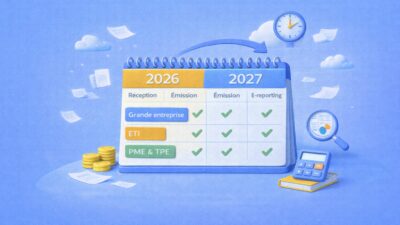

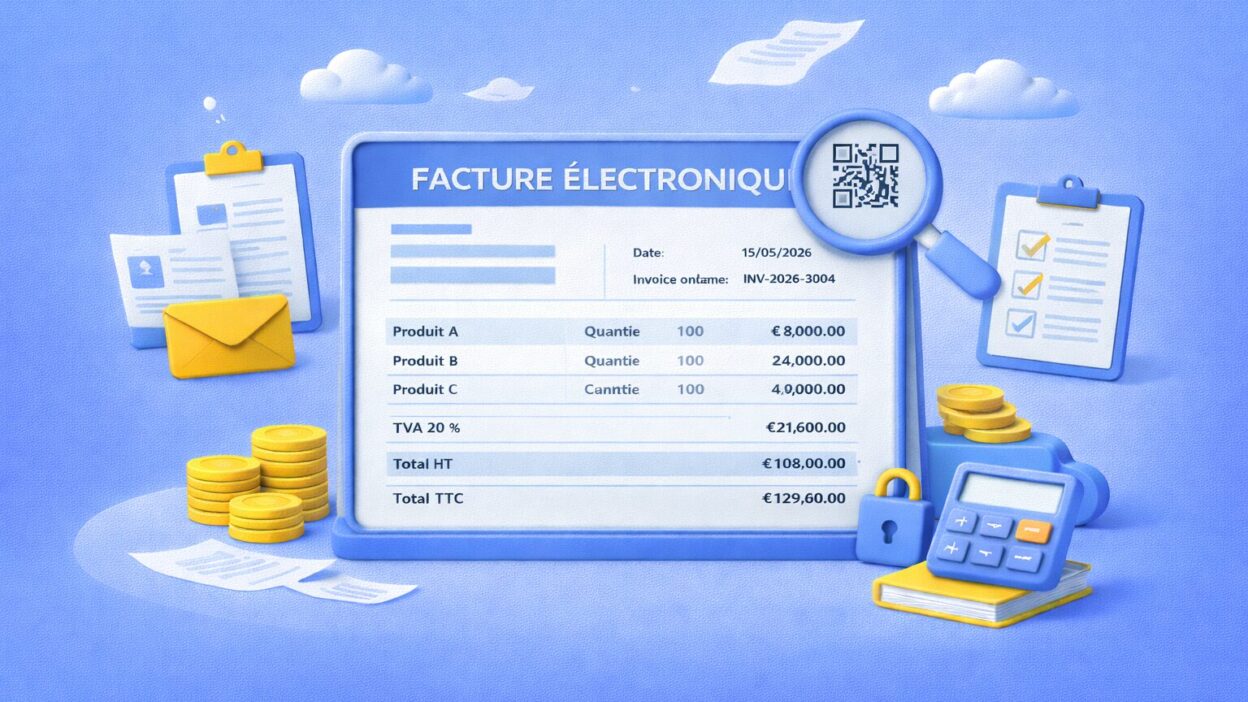
The digital transformation of financial processes is an unavoidable reality for businesses. At the heart of this revolution, electronic invoicing is establishing itself as a central pillar, not only to modernize exchanges, but also to strengthen fiscal compliance and optimize management. The 2026/2027 reform, with its progressive timeline, does not merely digitize invoices: it fundamentally redefines the very nature of “mandatory mentions”. What was once a list of information to be visually affixed to a document is now becoming a requirement for structured, coherent, and controlled data.
Until now, an invoice was validated by the visual presence of certain information. With the advent of electronic invoicing, this approach becomes obsolete. The reform requires that mentions be not only present, but also and especially correctly structured, exploitable by information systems, and subject to automated controls at the moment of issuance. This evolution marks a paradigm shift: compliance moves from post-facto verification to upstream validation, even before the invoice reaches its recipient.
This expert article from Weproc aims to decipher the impact of this reform on mandatory mentions. We will explore how “classic” requirements have transformed, what new information has become essential, and how businesses can anticipate these changes to guarantee their compliance, secure their payment flows and, ultimately, transform a regulatory constraint into a genuine lever for operational and financial performance.
⏱️ The Essentials in 2 Minutes
- Electronic invoicing is a flow of structured data, far beyond a simple PDF, requiring rigorous technical compliance of mentions.
- Mandatory mentions now condition the technical and fiscal validity of the invoice, with automated upstream controls by Certified Platforms (PA).
- New mentions, such as recipient identifier and transaction category, are crucial for routing and fiscal reporting.
Understanding the Reform: From PDF Invoice to Electronic Invoice
The electronic invoicing reform, whose progressive enforcement is planned from 2026, represents much more than simple digitalization. It is a profound structural change that modifies how businesses exchange, process, and report their invoices. To grasp the scope of this transformation, it is essential to understand the fundamental distinction between the invoice as we knew it (often in PDF format) and the electronic invoice in the regulatory sense.
The legal framework: the essence of mentions (unchanged in substance)
Before addressing innovations, it is essential to recall that the foundation of mandatory mentions has not changed. Current legal requirements remain the basis of all invoicing, whether paper, PDF, or electronic.
In France, Article 289 of the General Tax Code (CGI) is the cornerstone of invoicing obligations. This text, together with other VAT law provisions, exhaustively defines the information that must appear on an invoice issued by any business subject to VAT. The objective is clear: to guarantee traceability of operations, ensure fiscal transparency, and enable the tax authority to collect VAT and businesses to deduct it correctly.
An invoice is not merely a simple commercial or accounting document. Its fiscal role is paramount. It serves as proof for VAT application, for calculating taxable bases, and for justifying deductions. A non-compliant invoice can have significant consequences, ranging from denial of VAT deduction to financial penalties in case of audit.
A crucial point, often misinterpreted, is that the legal validity of mentions is not intrinsically linked to the document format. Whether the invoice is printed on paper, sent as a PDF, or transmitted as structured data, the information to be provided remains, in substance, the same. The reform does not add new legal obligations in terms of informational content, but it radically changes how this information must be presented, transmitted, and controlled. This distinction is fundamental to understanding the transformations to come.
The major shift: from unstructured document to data
The true shift introduced by the reform lies in the transition from “document” to “data”. This evolution gives a completely new dimension to mandatory mentions.
Until now, the PDF format, although digital, has remained an unstructured document from the perspective of information systems. The information it contains is primarily intended to be read and interpreted by a human. For it to be exploitable by a computer system, it requires additional processing (optical character recognition – OCR, manual entry, etc.), often sources of errors and delays. In this model, the presence and consistency of mandatory mentions were verified after the fact, manually, or during late tax audits, which left considerable room for corrections or disputes after issuance and sometimes even after payment.
Conversely, the electronic invoice, as defined by the 2026/2027 reform, is no longer a mere visual document. It is a genuine flow of structured data. Each mandatory mention is encapsulated in a precise, standardized data field that is machine-readable. This data is transmitted via an official circuit and is subject to automated controls upstream, that is, before even reaching the final recipient or the tax authority. A missing, poorly formatted, or inconsistent mention can now block the invoice at the moment of issuance.
This shift from visual compliance to data compliance is a radical change in logic. Previously, as long as the invoice “looked correct” and visually contained the required information, it was considered valid. Tomorrow, appearance will no longer suffice. It is the underlying data, its structure, its accuracy, and its consistency, that will determine invoice validity. Errors will no longer be detected after the fact, but prevented or flagged at the moment of issuance, which requires businesses to exercise greater rigor right from the source of their information.
Classic Mandatory Mentions: New Structuring Requirement
The foundation of mandatory mentions, as defined by the General Tax Code, remains the reference. However, electronic invoicing brings a new requirement: this information must be not only present, but also and especially perfectly structured in the data transmitted. A mention that would be readable in the “image” part of a Factur-X invoice but absent or poorly coded in the “data” part will be considered missing, with potential rejection consequences.
Identification of parties and invoice references
Precise identification of seller and buyer is the first cornerstone of any invoice. In the electronic context, this identification takes on an additional technical dimension.
The invoice must necessarily contain the complete identity of the seller (business name or name, legal form if relevant) as well as the complete identity of the buyer. The same applies to the address of the registered office or establishment in question for each party. This information is not mere strings of characters; it must be structured in specific fields and be strictly consistent with official repositories, particularly SIREN/SIRET numbers. An error in these identifiers or a mismatch with the electronic invoicing directory can result in the invoice being blocked from routing.
Each invoice must also be assigned a unique number, based on a continuous chronological sequence, guaranteeing its integrity and traceability. The invoice issuance date, as well as the date of sale or service provision (if different from the issuance date), are essential information. They allow the operation to be linked to the correct fiscal period and ensure precise traceability of economic flows. The compliance of these dates is crucial for calculating payment periods and for tax filings.
Details of goods, services, and VAT
The heart of the invoice lies in the precise description of commercial operations. In electronic invoicing, this implies increased granularity and structuring.
The description of goods delivered or services provided must be clear, unambiguous, and concise. Each invoice line must indicate the quantity invoiced and the unit price excluding tax. These elements allow not only easy understanding of the operation, but also automated matching with purchase orders or contracts, thereby reducing disputes and data entry errors. In electronic formats, this information consists of distinct and mandatory fields for each invoice line.
VAT, being a major tax, requires great rigor. The electronic invoice must indicate the applicable VAT rate for each product or service line, as well as the corresponding VAT amount. The total excluding tax and the total including all taxes (TTC) of the invoice must be calculated and presented accurately. In case of specific VAT regimes, explicit and compliant mentions are required. These may include VAT exemption notices (Article 261 and following of the CGI), reverse charge (for intra-community operations or subcontracting services in construction, for example), VAT exemption threshold (for small businesses), or other special regimes. These qualifications are directly used by the tax authority and must be rigorously codified according to electronic format standards.
Payment terms and due dates
Payment terms are a vital element for cash flow management for businesses. The electronic invoice must integrate this information in a structured manner to facilitate controls and optimize financial processes.
The invoice must clearly indicate the payment terms agreed between the seller and buyer. This includes payment methods (bank transfer, direct debit, check, etc.), payment periods granted (for example, net 30, net 45, etc.) and any payment facilities. This information is crucial for debt tracking and cash flow forecasting.
The payment due date, calculated according to the agreed terms, must be explicitly stated. This date is an essential legal and commercial reference point. In case of non-compliance with this due date, the invoice must also specify the late payment penalty rate applicable, in accordance with legal provisions (Article L441-10 of the Commercial Code). Additionally, the lump-sum indemnity for collection costs, owed in case of payment delay in commercial transactions, must be mentioned. These mentions, although not new in substance, must be integrated in a structured manner to be fully exploitable in an electronic invoicing environment and avoid disputes.
In summary, “classic” mentions do not disappear, but their nature evolves. They move from simple visual presence to a requirement for precise structuring, conditioning the technical validity of the invoice and its automated processing. This is a major challenge for businesses, which must review their information collection and management processes.
New Essential Mentions in Electronic Format
Beyond the enhanced structuring of “classic” mentions, the electronic invoicing reform introduces new mandatory information. These mentions, often invisible on a traditional paper or PDF invoice, are nonetheless crucial for proper invoice routing, transaction qualification, and the operation of e-reporting mechanisms. Their absence or inaccuracy will be a frequent cause of invoice rejection from 2026 onwards.
Routing and transaction qualification
In an electronic invoicing ecosystem, invoice routing is no longer a matter of simple email address. It is based on structured identifiers and precise qualifications.
The recipient identifier has become a paramount mention. Each electronic invoice must include a unique identifier that allows routing the invoice to the buyer’s platform. This is generally the client’s SIREN or SIRET number, or a specific identifier declared in the electronic invoicing directory (such as the directory of the Public Invoicing Portal – PPF). Without this precise identifier, the issuing platform simply cannot route the invoice to the correct recipient, blocking the entire process. This is a significant departure from sending a PDF by email, where the email address was sufficient.
Transaction category qualification is another key requirement. The invoice must indicate the nature of the commercial operation to determine its fiscal and reporting treatment. This qualification makes it possible to distinguish whether the transaction falls under:
- Domestic B2B (between VAT-liable parties established in France): these are invoices subject to e-invoicing.
- B2C (between a VAT-liable party and a consumer): these operations are not subject to e-invoicing, but to e-reporting.
- International (with a VAT-liable party not established in France or a non-liable party): also subject to e-reporting.
- Or a specific case (ex: VAT exemption threshold), also subject to e-reporting.
This information is essential because it determines the transmission circuit (e-invoicing via Certified Platforms or the PPF, or e-reporting directly to the PPF) and the type of tax data to transmit to the tax authority. The consistency between the declared transaction category and other invoice data (VAT, client identifier) is crucial.
Supplementary information and invoice lifecycle
Other information, which was previously optional or implicit, becomes mandatory in specific contexts, thus supplementing the structured data of the invoice.
When the delivery address differs from the billing address, this information must be explicitly entered in the structured data of the invoice. This detail is particularly important for businesses managing complex logistics flows or subject to specific VAT rules depending on the place of delivery. Its presence guarantees information consistency and facilitates controls (intra-community VAT, merchandise flows, matching with delivery notes).
The payment method, although not systematically mandatory for all transactions, may become expected data in certain scenarios, particularly when it impacts the tracking of receipts or e-reporting requirements. For example, for B2C or international operations subject to e-reporting, payment dates and amounts must be reported. Knowledge of the payment method can be useful for linking this information and ensuring reporting compliance.
Electronic invoicing also introduces the concept of invoice lifecycle. Precise statuses must be tracked and transmitted via platforms. These statuses, which are not always “visible” on the PDF rendering of the invoice, form an integral part of tracking and e-reporting obligations. We find statuses such as:
- Submitted: The invoice has been issued and transmitted to the platform.
- Rejected: The invoice was refused by the platform or by the client for non-compliance.
- Accepted: The client has validated the invoice.
- Payment Processing: The invoice is being processed for payment.
- Paid: The invoice payment has been received.
These statuses enable real-time tracking of the state of receivables and payables, thereby improving the financial visibility of businesses and the fluidity of relations with their partners.
📈 Diagram of Electronic Invoice Lifecycle
Specific data for e-reporting
Even when the invoice falls under e-invoicing (domestic B2B), certain supplementary information may be necessary to meet e-reporting obligations.
E-reporting is the mechanism for transmitting transaction data to the tax authority that does not fall under e-invoicing (B2C, international, certain specific operations). VAT information is central to this mechanism. It may concern total VAT collected amounts, receipt amounts by VAT rate, or applicable specific regimes. This data enables the tax authority to pre-populate VAT filings and exercise more effective control.
Receipt amounts and dates are also key information for e-reporting. For B2C and international transactions, reporting is not based on the invoice issuance date, but on the date of payment receipt. It is therefore essential to collect and transmit this information accurately for each transaction concerned.
In summary, new mentions are not always visible, but they are omnipresent in the data flow. Their mastery is a major technical compliance issue, requiring a review of internal processes for information collection and management.
Electronic Formats and Controls: Technical Compliance
The transition to electronic invoicing is not limited to simply having information present; it requires rigorous structuring of that information. Mandatory mentions become “data fields” and their compliance is now a technical matter, subject to standards and automated controls. This is where a fundamental part of invoice validity is at stake.
Mentions as standardized data fields
In the world of electronic invoicing, mentions are no longer free text elements but information coded according to international and national standards. This standardization is the key to automating processing.
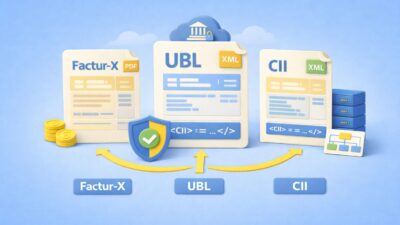
The electronic formats authorized in France, such as Factur-X (a hybrid format that combines a readable PDF and structured XML data), UBL (Universal Business Language) and CII (Cross Industry Invoice), are designed to structure invoicing data. In these formats, each mandatory mention corresponds to a precisely defined field in a data schema. For example, the identity of the seller and buyer, invoice number, gross amounts, VAT and total amounts, invoice or delivery date, and VAT or payment information are all specific fields. These fields are not free: they must respect a name, a format (numeric, alphanumeric, date), a position and consistency rules imposed by the standard.
The European standard EN 16931 is at the core of this structuring. It defines the “Core Invoice Usage Specification” (CIUS), that is, a minimal set of data and semantic rules for an electronic invoice. This standard ensures that, regardless of the technical format (Factur-X, UBL, CII), essential information is present and can be interpreted uniformly. The EN 16931 standard specifies not only the list of mandatory data, but also calculation rules (VAT, totals), dependencies between fields (e.g., a VAT rate implies a VAT amount), and conditional cases (exemption mentions, reverse charge, specificities of international transactions).
The major consequence of this approach is that “a poorly structured mention is considered absent”. A Factur-X invoice can present a visually flawless PDF, but if the embedded XML file contains a formatting error, a missing field, or data inconsistency (for example, an incorrectly entered SIREN or a non-compliant VAT rate), the invoice will be technically non-compliant and potentially rejected. In electronic invoicing, it is the underlying data that is authoritative, not the visual rendering.
The crucial role of Certified Platforms (PA)
To ensure this technical compliance of data, the Dematerialization Partner Platforms (DPP), now more commonly called Certified Platforms (PA) in everyday language, play a central role. They are the first control barrier in the new invoicing circuit.
Certified Platforms are mandated by the State to verify that electronic invoices comply with regulatory and technical requirements before transmission to the recipient and to the Public Invoicing Portal (PPF). Concretely, they perform automated and systematic controls on each issued invoice:
- Structure controls: Verification of the presence of all mandatory fields according to the format used (Factur-X, UBL, CII) and compliance with the associated XSD schema.
- Consistency controls: Ensuring that amount calculations are correct (gross, VAT, total), that the VAT applied corresponds to declared rates, that seller and buyer information is consistent, etc.
- Regulatory controls: Compliance with EN 16931 standard rules and specific obligations of French law (e.g., exemption mentions).
If a mandatory mention is absent, poorly structured or inconsistent, the PA platform has the power to block or reject the invoice. This action occurs before the invoice even reaches the recipient’s information system, thus protecting the buyer from receiving non-compliant invoices and the issuer from potential tax penalties or payment delays.
It is fundamental to understand what the Certified Platform does not do: it does not correct the invoice. A PA will not modify erroneous data, will not fill in a missing field, and will not make decisions regarding the applicable VAT regime or transaction category. Its role is to control the technical compliance of transmitted data and, if necessary, to report errors to the issuer. The responsibility for data quality and accuracy therefore remains entirely with the issuing company.
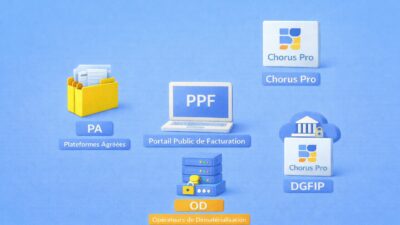
The Public Invoicing Portal (PPF), operated by the State, intervenes in coordination with PA platforms. It ensures the centralization of invoicing data (e-invoicing) and transaction data (e-reporting) transmitted by PA platforms or directly by companies. The Tax Administration (DGFIP) relies on this data to feed its VAT control systems and, ultimately, to prepare pre-filling of tax returns. The PPF and DGFIP do not validate each invoice individually at the same level as the PA platforms, but exploit data already deemed compliant by them.
This architecture implies for companies an unprecedented level of anticipation. Compliance is no longer played out after the fact, but from the moment of issuance. It is therefore imperative to secure the quality of mandatory mentions at the source, within the company’s own invoicing systems and data repositories, rather than relying on correction or “processing” by the platform.
Risks of Non-Compliance and Anticipation Strategies
The entry into force of electronic invoicing radically transforms the impact of errors or omissions in mandatory mentions. What was once a source of manual correction or minor disputes can now lead to automatic blocks and significant consequences for the company’s financial and operational health. Anticipating these risks is a strategic approach.
Direct consequences of invoice rejections
The main immediate risk in case of non-compliant invoice is its rejection by the certified platform or by the Public Invoicing Portal. This rejection is not a simple notification; it has cascading repercussions:
- Blocked flows: A rejected invoice is not transmitted to the client and therefore cannot be integrated into their accounting system. The invoicing circuit is interrupted.
- Payment delays: Since the invoice is not valid or has not reached the buyer, payment is mechanically delayed. These delays can affect the cash flow of the issuing company and potentially create tensions with suppliers.
- Commercial disputes: Back-and-forth corrections and re-issuances of non-compliant invoices generate additional administrative burden and can damage the commercial relationship with customers. A customer is entitled to refuse payment of a non-compliant or unreceived invoice under the new modalities.
Beyond operational impact, tax penalties are provided for in case of failure to meet electronic invoicing obligations. Article 1737 of the General Tax Code provides for a fine of 15 euros per invoice for each missing or inaccurate mandatory mention. Although an annual ceiling of 15,000 euros per fiscal year is set, these fines can quickly become significant for companies handling large volumes of invoices. To this can be added penalties for failure to meet e-reporting obligations or transmission of tax data.
This new context demands a change in logic: error can no longer be corrected after the fact, but must be prevented upstream. Compliance must be a priority from the moment of invoice issuance.
Securing compliance at the source
To avoid rejections and penalties, the most effective strategy is to ensure compliance of mandatory mentions from the source. This involves an overhaul of data management practices and increased involvement of information systems.
The reliability of mentions begins with the quality of the company’s data repositories. Information relating to customers, suppliers, items, VAT rates, payment terms must be complete, accurate and consistent. If this data is erroneous or incomplete in the ERP or CRM, the generated electronic invoices will mechanically be non-compliant. The time for manual correction after the fact is over; what is needed is the structuring and securing of data upstream. This is a necessary investment in data governance.
Digital tools play a decisive role in this securing:
- ERP (Enterprise Resource Planning) and invoicing software: They are responsible for generating and structuring emission data. Their configuration must ensure that all mandatory mentions are collected and formatted correctly according to EN 16931 standard and the chosen format.
- Procure-to-Pay (P2P) and e-procurement solutions: For receiving supplier invoices, these solutions are critical. They enable secure integration of incoming invoices, automatically control their compliance against mandatory mentions and associated orders, and orchestrate validation and payment flows.
- Certified Platforms (PA): They verify the technical and regulatory compliance of flows, but as mentioned previously, they do not correct substantive errors.
An often underestimated point is the critical importance of receiving invoices. In many organizations, the volume of incoming invoices is high, formats can be heterogeneous, and supplier compliance maturity varies. A non-compliant supplier invoice received immediately blocks the buyer’s payment cycle. The ability to automatically control mandatory mentions upon receipt, to detect discrepancies and to manage exceptions becomes a strategic advantage to avoid payment delays and disputes.
| Non-Compliance Risk | Direct Consequence | Weproc Anticipation Strategy |
|---|---|---|
| Missing or poorly structured mandatory mention | Invoice rejection by PA, flow blockage | Securing supplier and customer data repositories upstream. |
| Inconsistency between data (e.g.: SIREN / SIRET or VAT) | Payment delays, disputes, tax fines | Automated controls pre-issuance and pre-integration via P2P solutions. |
| Improper transaction qualification (B2B/B2C/International) | E-reporting issues, tax non-compliance | Tool integration with business intelligence for routing and classification. |
| Inadequate management of invoice lifecycle | Lack of visibility, difficulty tracking collections | Centralization and automated status tracking of invoices in P2P. |
| Lack of mastery of electronic formats (Factur-X, UBL, CII) | Technical rejections and administrative overload | Support by a PA for issuance and P2P solution for receipt. |
Adopting a proactive approach, by acquiring the right tools and structuring data at the source, is the only way to transform regulatory constraint into competitive advantage. It is no longer about “managing” non-compliance, but about eliminating it.
Toward Simplified Management of Mandatory Mentions
The requirement for electronic invoicing by the horizon of 2026/2027 represents a major challenge for financial departments. However, beyond the constraint, it is a unique opportunity to modernize processes, improve data reliability and achieve performance gains. Simplified management of mandatory mentions is within reach for companies that adopt a pragmatic and tool-enabled approach.
Performance lever for the finance function
In the new paradigm, mandatory mentions are no longer simple administrative “boxes to check”; they become critical data that feed a structured digital flow. Each piece of information on the invoice – identity of the parties, detail of transactions, VAT, references, statuses – is now exploited by automated systems and by the tax administration. It is a goldmine for the finance function if properly managed.
Anticipating the compliance of these mentions is first and foremost about securing your financial flows. By ensuring that each invoice is technically and fiscally valid from the moment of issuance or receipt, companies drastically reduce the risks of rejections, payment delays and supplier disputes. This flow fluidity positively impacts cash flow, the predictability of collections and payments, and the relationship with the commercial ecosystem.
The reform offers the opportunity to transform a regulatory requirement into genuine operational rigor. By ensuring data quality and structuring at the source, companies not only improve their compliance, but also the reliability of their reporting, the accuracy of their financial analyses and the efficiency of their accounting processes. It is a giant step toward a more agile, transparent and strategic finance function.
Adopting a pragmatic and tool-enabled approach
To navigate successfully in this new landscape, companies must adopt a pragmatic approach, combining a clear understanding of the issues and the adoption of suitable tools. The complexity inherent to electronic formats and regulatory requirements must not be underestimated.
Mastering the receipt of incoming e-invoices is a critical point. This is often where difficulties crystallize, as the company depends on the compliance of invoices issued by its suppliers. A Procure-to-Pay (P2P) solution like Weproc is essential to manage this challenge. It enables centralizing the receipt of all electronic invoice formats, ensuring their conversion if necessary, and guaranteeing their technical and regulatory compliance before any integration into the ERP.
Automatic control of data compliance is the second pillar of simplified management. Thanks to pre-configured and adaptable rules engines, a P2P solution can verify the presence and consistency of all mandatory mentions, VAT rates, SIREN/SIRET identifiers, and invoice statuses. Any discrepancy is detected and flagged upstream, allowing for quick correction before the invoice blocks the payment process.
Finally, ensuring reconciliation with purchase commitments is a crucial step for operational efficiency and budget control. A received electronic invoice must be able to be automatically reconciled against a purchase order or contract, thus guaranteeing that only authorized expenditures are processed. This automation drastically reduces invoice processing time, minimizes manual errors and frees financial teams for higher value-added tasks.
| Compliance Checklist for Mandatory Mentions with Weproc |
|---|
| ✅ Unique identifiers: SIREN/SIRET and invoice numbers guaranteed correct and unique. |
| ✅ Complete designation: Labels, quantities, unit prices excluding VAT verified against orders. |
| ✅ VAT and taxation: Rates, amounts and exemption/reverse charge mentions automatically controlled. |
| ✅ Payment terms: Due dates and late payment penalties clearly filled in and tracked. |
| ✅ Recipient identifier: Customer SIREN/SIRET verified and used for routing. |
| ✅ Transaction category: Automatic qualification (B2B, B2C, international) for e-reporting. |
| ✅ Invoice lifecycle: Real-time tracking of statuses (filed, accepted, collected). |
| ✅ Format compliance: Support for Factur-X, UBL, CII and EN 16931 validation. |
| ✅ Automated reconciliation: Invoice controlled and reconciled with purchase orders. |
Weproc, as a complete P2P software, enables companies to master their entire procurement and invoicing process, from commitment to payment. By integrating advanced dematerialization and control functionalities, Weproc helps Financial Departments anticipate electronic invoicing requirements, secure compliance of mandatory mentions and transform this reform into an opportunity for rationalization and efficiency.
Electronic invoicing, with its new requirements for mandatory mentions, is an inevitable and necessary step for modernizing the economy. Far from being a simple technical constraint, it represents a powerful lever for companies wishing to optimize their financial processes, reduce their risks and improve their overall performance. By adopting a rigorous approach and relying on solutions like Weproc, Financial Departments can approach this transition with confidence, transforming mandatory mentions into a strategic asset for more transparent, more efficient and resolutely future-oriented management.