
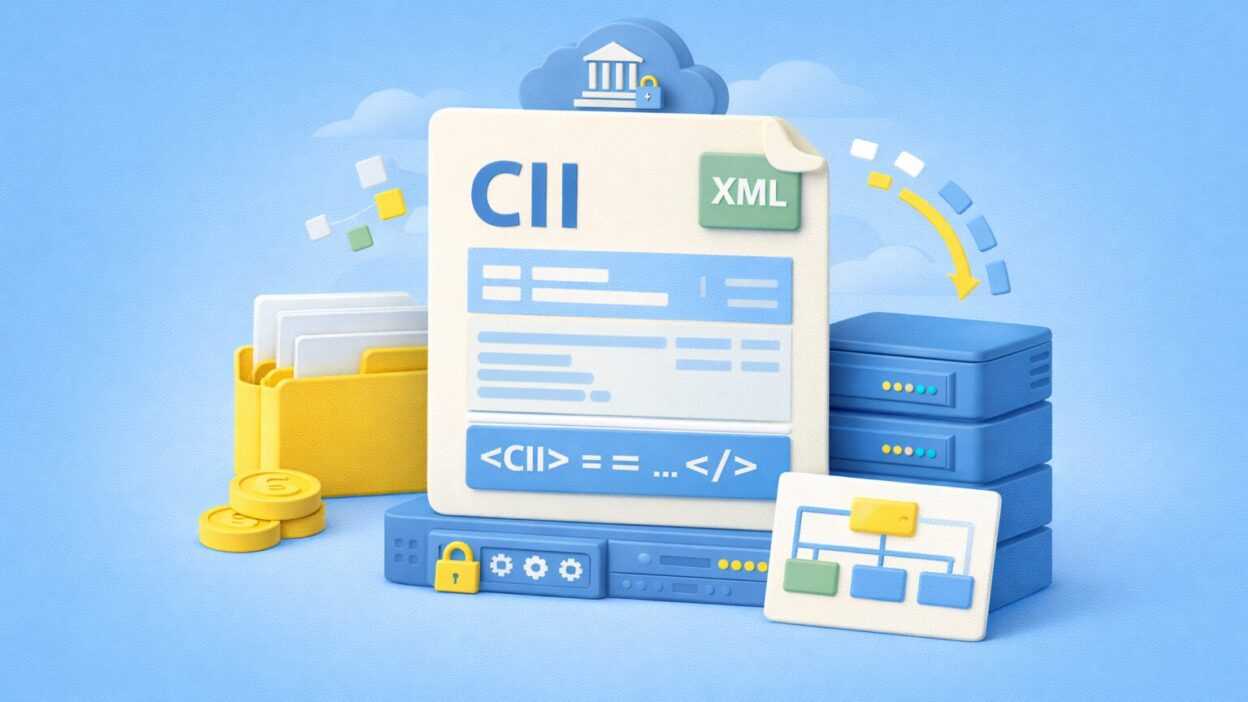
The CII (Cross Industry Invoice) format is one of the formats of electronic invoicing officially accepted in France as part of the 2026–2027 reform, on the same level as Factur-X and UBL, but it remains the most normative and structuring for complex information systems.
With the progressive implementation of mandatory electronic invoicing starting in 2026, French companies must adapt their practices and rely on electronic invoice formats that comply with the new regulatory framework. This reform, which we detail in our comprehensive guide on electronic invoicing, requires the use of structured formats recognized by the administration, which now form the foundation of B2B exchanges.
Among these formats, some are widely known, such as Factur-X or UBL. Others remain more confidential, but play a strategic role in highly structured environments. This is the case with the CII (Cross Industry Invoice) format, an electronic invoice format entirely structured in XML, designed for automated and standardized exchanges between information systems.
Unlike hybrid formats, CII does not seek to reproduce a human-readable invoice. It prioritizes data precision, interoperability and strict compliance with European standards, making it a format particularly suited to mature organizations, large transaction volumes or international contexts.
But the CII format is not a universal choice. Its relevance depends heavily on your level of technical tools, your Procure-to-Pay processes and your invoicing volumes. To better understand the place of CII relative to other formats authorized under the regulatory framework, you can also consult our dedicated page on formats of electronic invoices accepted in France.
In this guide, we will clarify what the CII format really is, who it is intended for, and in what contexts it represents the best choice.
What is the CII format?
The CII format, for Cross Industry Invoice, is a fully structured electronic invoice standard, based exclusively on data in XML format. Unlike hybrid formats, CII contains no visual document intended for human reading: it is designed from the outset to be interpreted and processed automatically by information systems.
The CII format was developed at the European level as part of work conducted by UN/CEFACT (United Nations Centre for Trade Facilitation and Electronic Business), an international body responsible for defining common standards for electronic business exchanges. Its objective is clear: to enable interoperable, reliable and standardized invoice exchanges, regardless of the industry sector or country involved.
In the context of electronic invoicing, an invoice in CII format is therefore a structured XML file, describing in a precise and standardized manner all invoicing information. It notably contains:
-
complete identification of the sender and recipient (entities, identifiers, addresses),
-
invoice references (number, issue date, currency),
-
line-by-line details of products or services invoiced,
-
amounts before tax, VAT and totals,
-
VAT rules applied,
-
payment conditions and terms,
-
order or contract references, where applicable.
All this information is encapsulated in standardized XML tags, which guarantees uniform interpretation by software, without ambiguity or manual re-entry.
The CII format complies with the European standard EN 16931, which defines the common foundation of mandatory data for electronic invoices within the European Union. This compliance ensures that CII invoices meet both French regulatory requirements and European standards, particularly in cross-border exchange contexts.
In practice, CII is primarily intended for already highly digitalized environments, where data exchanges are automated and direct human readability of the invoice is not a prerequisite. It is particularly suited to organizations with systems capable of generating, receiving and processing complex XML flows, in a logic of streamlining invoicing processes.
Format 100% structured XML, with no visual component
European standard from UN/CEFACT work
Compliant with the EN 16931 standard
No native PDF, human reading via tools only
Designed for complex and interoperable information systems
Why CII is a normative XML format (and what this implies)
The CII format is distinguished by its strongly normative nature. While some formats primarily seek to facilitate adoption or transition, CII prioritizes strict compliance with international standards and precision in data exchanges. This orientation has direct consequences for how it is used and the contexts in which it is truly relevant.
Less pragmatic than a hybrid format like Factur-X, CII offers no compromise on human readability. It contains no PDF and does not seek to adapt to “paper” or semi-digitalized uses. Conversely, it is more normative than UBL on certain aspects, as it fits within a broader conceptual framework, designed for highly regulated cross-sectoral and international exchanges.
The structure of CII is rigid and highly standardized. Each piece of invoice information must be positioned in a precise tag, according to a strict data model. This rigor guarantees uniform interpretation by information systems, but leaves little room for approximations or local adaptations. Missing, poorly structured or inconsistent data can result in outright invoice rejection.
This low tolerance for deviations is both a strength and a constraint. On the advantages side, the CII format offers a very high level of reliability, maximum data precision and excellent interoperability between systems, including in multi-country or multi-ERP contexts. It greatly reduces ambiguities and interpretation errors, which is crucial in complex environments.
In return, CII imposes strong dependence on tools capable of correctly generating, controlling and interpreting XML. It requires well-structured reference data, rigorous parameterization and high digital maturity. Without this technical ecosystem, the format quickly becomes difficult to exploit daily.
In summary, CII is not a “flexible” or “educational” format. It is a demanding standard, designed for organizations that prioritize compliance, robustness and large-scale interoperability, at the cost of higher operational complexity.
CII in electronic invoicing in France: role and uses
Within the French electronic invoicing framework, the CII (Cross Industry Invoice) format is part
Concretely, CII integrates into the new invoice circulation scheme, based on approved platforms (PA) and the Public Invoicing Portal (PPF). The invoice is issued in CII via an approved platform, transmitted to the recipient’s reception platform, then the necessary invoicing data is relayed to the tax authority via the PPF, particularly for control purposes and pre-filling VAT declarations.
The role of CII in this framework is primarily that of a reliable and standardized data format, perfectly suited to the automated transmission of tax information. Its rigorous XML structure facilitates the extraction, control and exploitation of VAT data by tax authority systems, while guaranteeing high consistency between the different platforms involved.
In practice, the CII format is less widespread than Factur-X on the French market. It is rarely chosen as the default format, particularly by SMEs and mid-market companies, as it does not offer readable support for the end user and requires a more advanced technical environment.
CII is primarily used in highly structured environments, where exchanges are already standardized and largely automated: large organizations, international groups, industrial ecosystems or multi-ERP contexts. In these specific cases, its rigor and alignment with international standards constitute a real advantage.
Thus, in French electronic invoicing, CII is not a marginal format, but a specialized format, intended for well-identified uses, where precision and interoperability take precedence over ease of adoption.

CII vs UBL vs Factur-X: when CII is the right choice
Within the framework of electronic invoicing in France, CII, UBL and Factur-X are all legally compliant. The choice between these formats is therefore not based on regulation, but on the fit between the format and your organization. CII stands out for its very normative and international positioning, which makes it relevant in specific contexts.
Comparison of formats according to key criteria
Human readability
Factur-X is the only format to natively integrate a readable PDF. UBL and CII are pure XML formats, requiring a tool to generate a visual output. On this point, CII is the most distant from conventional “documentary” practices.
Technical complexity
CII is the most demanding format. Its highly regulated structure requires precise data parameterization, strict XML schema compliance and low tolerance for deviations. UBL is also structured, but often perceived as more pragmatic. Factur-X remains the most technically accessible.
Volume and automation
CII is particularly well-suited to large volumes and industrial flows. It enables maximum automation of invoice processing, with a high level of reliability. The higher the volume, the greater the interest in CII.
International dimension
CII is strongly oriented toward international interoperability. Derived from UN/CEFACT work, it is designed to operate in multi-country, multi-standard and multi-ERP environments. On this criterion, it is often more relevant than Factur-X.
Procure-to-Pay and complex IT systems
In highly structured Procure-to-Pay chains, with multiple interconnected systems, CII integrates naturally. Its rigidity then becomes an advantage, as it guarantees high data consistency across the entire chain.
When to choose the CII format?
The CII format is particularly relevant if:
-
you operate in an international environment or multi-subsidiary,
-
your information systems are complex and already highly integrated,
-
you have high normative requirements for data quality and traceability,
-
your flows are predominantly machine-to-machine, with no need for readable documents.
When to avoid the CII format?
CII is generally discouraged if:
-
you are a poorly equipped SME or in digital transition,
-
your teams need a readable PDF for daily controls,
-
your priority is a quick deployment and gradual regulatory framework implementation,
-
your suppliers are heterogeneous from a technical standpoint.
Choosing the right format
-
Factur-X: facilitated transition, human readability, broad adoption
-
UBL: strong automation, pragmatic XML approach
-
CII: strict standard, international interoperability, complex environments
The best format is not the most technical, but the one that aligns with your processes, your tools and your maturity.
How to issue an invoice in CII format
Issuing an invoice in CII (Cross Industry Invoice) format requires a technical environment capable of producing and managing XML data strictly compliant with European standards. Unlike Factur-X, this is not a transition format, but a format designed for fully automated exchanges.
Rely on a compatible ERP or middleware
In practice, a CII invoice is generated by:
-
an ERP with an advanced electronic invoicing module,
-
or a specialized middleware capable of transforming invoicing data into compliant CII XML.
Manual generation of a CII file is unrealistic at operational scale. Tooling is therefore an essential prerequisite.
Generation of XML compliant with the standard
The CII file must scrupulously comply with:
-
the European standard EN 16931,
-
the XML structure defined by UN/CEFACT,
-
consistency rules between amounts, lines and VAT.
Each expected field must be correctly populated. CII leaves very little room for approximation: missing or poorly structured data can result in rejection.
Rigorously parameterize data upstream
To issue reliable CII invoices, the company must have:
-
complete customer and supplier reference databases,
-
properly codified VAT rules,
-
standardized articles or services,
-
strictly controlled invoicing processes.
The quality of upstream data directly conditions the success of issuance.
The issuance process, step by step
-
Production
The invoice is generated in the ERP or source system from transactional data. -
Validation
Automatic controls verify the compliance of the CII file (structure, amounts, tax rules). -
Transmission
The invoice is transmitted via an approved platform, which ensures:-
regulatory compliance,
-
transmission to the customer’s reception platform,
-
relaying of tax data to the administration via the PPF.
-
Once this process is in place, CII issuance becomes fluid, reliable and highly automated, but it requires a high level of maturity from the start.
How to receive and process a CII invoice
Receiving and processing an invoice in CII format involves managing an entirely structured data flow, with no human-readable documentary support by default. Unlike Factur-X, CII relies exclusively on a normative XML file, designed to be interpreted by information systems rather than users.
Reception via an approved platform
Under mandatory electronic invoicing, a CII invoice never passes through email. It is received via an approved platform declared as the official reception point for the company.
This platform ensures:
-
secure receipt of the CII XML file,
-
format compliance checks,
-
transmission of tax data to the authorities via the Public Invoicing Portal,
-
routing to the company’s internal reception system.
The invoice is therefore integrated into a tracked and regulated process from the moment of receipt.
Reading and processing via the information system
A CII invoice is not human-readable without a tool. It must be processed by:
-
an ERP,
-
accounting software,
-
or a Procure-to-Pay platform capable of interpreting CII XML.
The system reads structured data directly: amounts, lines, VAT, purchase order references, payment terms. XML becomes the source of truth, without re-entry or manual interpretation.
Visual rendering generated by the tool
To enable internal controls, tools typically generate a visual rendering from the CII XML.
This rendering:
-
allows teams to view the invoice,
-
facilitates accounting validations,
-
serves as a control support, with no independent documentary value.
This is not a PDF transmitted by the supplier, but a representation constructed from the data.
Natural integration into Procure-to-Pay
CII fully realizes its potential when integrated into a structured Procure-to-Pay process.
Thanks to data quality:
-
the purchase order / invoice reconciliation is automated,
-
discrepancies are detected immediately,
-
validations are accelerated,
-
payments are secured.
In this context, the invoice is no longer a document to be processed, but a data event that naturally integrates into the procurement–finance chain.
This is precisely the logic that makes CII a powerful format for highly equipped and automated organizations.
CII in advanced Procure-to-Pay
The CII format reveals its full potential when integrated into an advanced Procure-to-Pay (P2P), where the invoice is no longer a document to be processed but a data stream piloting the entire spend cycle. In this context, CII is not simply a compliant format: it is a tool for industrializing financial processes.
CII as the foundation for commitment management
In a mature P2P environment, management does not start with the invoice, but at the moment of commitment: purchase request, order, contract.
CII format allows linking the final invoice to these commitments with extreme precision thanks to:
-
standardized purchase order references,
-
strictly structured lines,
-
strong consistency between procurement and invoicing data.
Result: the invoice becomes an automatic confirmation of an already validated commitment, not a starting point for control. The finance director gains visibility, anticipation capability, and arbitration capacity.
Maximum automation of invoice processing
Thanks to its rigid XML structure, CII enables advanced automation:
-
accounting integration without re-entry,
-
automatic purchase order / receipt / invoice reconciliation,
-
systematic consistency checks,
-
smooth triggering of validation or payment workflows.
In a well-configured environment, the CII invoice can be processed without human intervention, except in exceptional cases. Processing becomes predictable, fast, and scalable.
Lasting reduction in disputes and anomalies
The strong standardization of CII format significantly reduces sources of disputes:
-
fewer VAT errors,
-
fewer line discrepancies,
-
fewer ambiguities about amounts or references.
Anomalies are detected upstream, at the data level, rather than after reviewing a document. Control becomes systemic rather than corrective.
Who is this model really for?
CII integration into an advanced P2P is primarily intended for:
-
large enterprises or multi-entity organizations,
-
highly equipped mid-sized companies with robust ERPs,
-
companies processing large volumes of invoices,
-
organizations seeking strong and lasting standardization.
For these organizations, CII is not a constraining format, but a financial performance accelerator, enabling streamlined flows, reduced processing costs, and strengthened overall spend management.
In an advanced Procure-to-Pay, CII is therefore not an isolated technical choice. It is a maturity choice, aligned with an industrialized and data-driven vision of the finance function.
CII, compliance and risks
The CII (Cross Industry Invoice) format fully complies with the regulatory framework for mandatory electronic invoicing in France. It is among the officially accepted formats by the tax authorities alongside Factur-X and UBL, and respects the requirements of the European standard EN 16931. As such, an invoice issued in CII format is legally compliant, provided it is transmitted via an approved platform and the transmitted data is complete and consistent.
A high level of compliance… with conditions
CII offers excellent regulatory compliance thanks to its strict XML structure. Each invoicing data element (identifiers, amounts, VAT, references) is standardized, which facilitates:
-
automatic controls,
-
transmission of tax data,
-
traceability required by authorities.
However, this rigor implies low tolerance for errors. Poorly structured data, an incorrect VAT rule, or a poorly configured reference database can result in invoice rejection by the platform or reception system.
Main risks to anticipate
Risks related to CII are not legal, but operational:
-
technical rejections of invoices non-compliant with CII schema,
-
payment blocks due to data errors,
-
strong dependence on tool quality and configuration,
-
difficulty correcting issues afterward without reprocessing the flow.
Unlike a hybrid format, CII does not allow “recovering” an invoice via a readable document: XML is authoritative.
Anticipating to secure
Using CII reliably therefore requires:
-
well-controlled information systems,
-
thorough testing before production deployment,
-
clear governance of invoice data.
When properly deployed, CII reduces non-compliance risks. If poorly prepared, it can conversely become a factor of rigidity and blocking.
The CII (Cross Industry Invoice) format is primarily aimed at organizations seeking a high level of standardization, reliability, and automation in their invoicing exchanges. Fully structured, normative, and compliant with the European standard EN 16931, it perfectly meets the requirements of the 2026-2027 electronic invoicing reform, but demands significant information system maturity in return.
CII is neither a transitional format nor a universal format. It is designed for complex, international, or highly industrialized environments, where human readability is secondary to data precision and interoperability between systems. When properly integrated into an advanced Procure-to-Pay, it becomes a powerful lever for reducing disputes, securing commitments, and financial management.
The right choice is therefore not the most normative format, but one that truly aligns with your processes, tools, and ability to leverage data. For some organizations, CII is an obvious standard. For others, it should remain a later step in the compliance trajectory.