
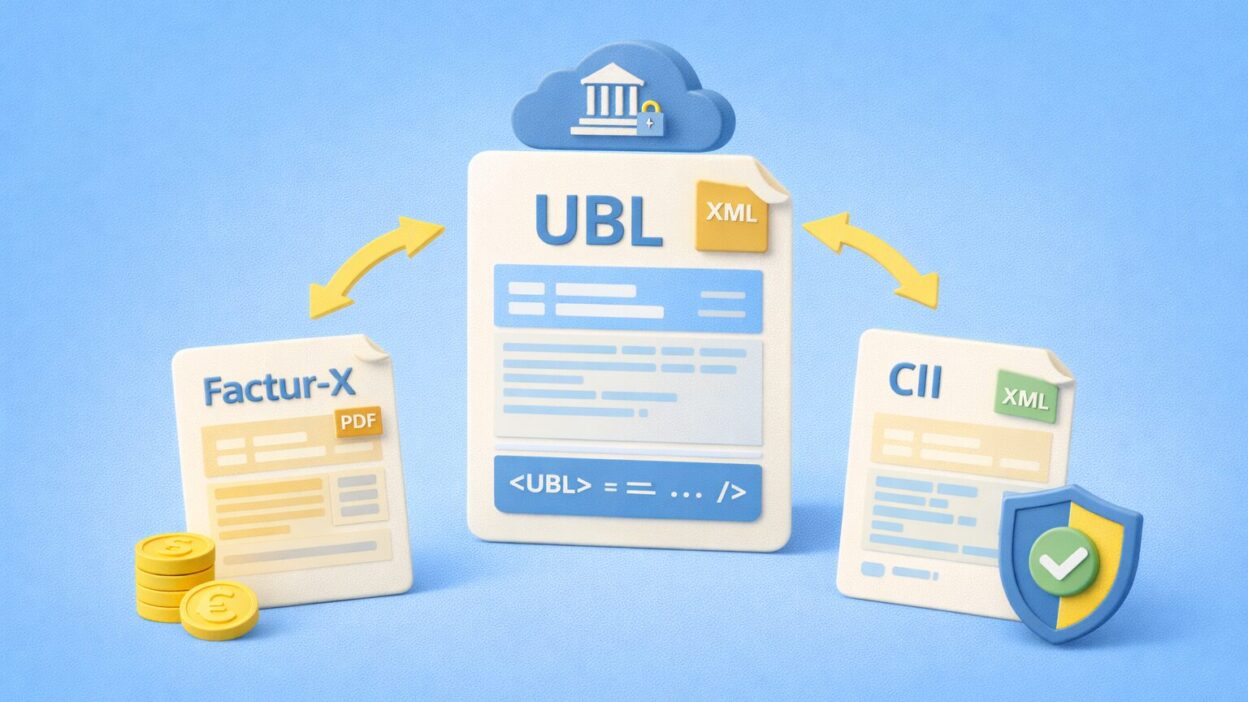
With the progressive introduction of mandatory electronic invoicing starting from 2026, French companies must adapt their practices and choose electronic invoice formats compliant with the new regulatory framework. This reform, detailed in our complete guide to electronic invoicing, requires the use of structured formats recognized by the tax authorities, among which are Factur-X, CII and UBL.
Among these formats, UBL (Universal Business Language) holds a specific place. It is an electronic invoice format entirely structured in XML, designed for automated integration into accounting systems, ERPs and Procure-to-Pay chains. Unlike other hybrid formats, UBL prioritizes data structuring over direct human readability, making it a preferred choice for certain organizations.
However, the UBL format is not suitable for all contexts. Its relevance depends heavily on the digital maturity of the company, its invoice volumes and existing tools. To better understand the differences between formats and their role in the reform, you can also consult our dedicated page on electronic invoice formats accepted in France.
In this article, we will explain what the UBL format really is, who it is for, when it is the best choice, and how to use it effectively within the framework of 2026–2027 electronic invoicing.
What is the UBL format?
The UBL format, for Universal Business Language, is an international standard for electronic documents based on XML (eXtensible Markup Language). It was designed to uniformly structure commercial exchanges between information systems, notably invoices, purchase orders, shipping notices or payment confirmations.
In the context of electronic invoicing, a UBL format invoice is therefore a file entirely structured, intended to be read and processed automatically by software, not to be consulted directly by a human.
A structured and standardized format
UBL is based on a standardized data model, shared internationally. Each piece of information on the invoice is integrated into a specific XML tag, which enables reliable and unambiguous interpretation by computer systems.
A UBL invoice notably contains:
-
the standardized identities of the sender and recipient (company name, identifiers, addresses),
-
the invoice references (number, issue date, currency),
-
the line-by-line detail of products or services invoiced,
-
the amounts excluding taxes, VAT and including all taxes,
-
the VAT rules applied (rates, exemptions, bases),
-
the payment terms and due dates,
-
order or contract references, where applicable.
This fine structuring makes UBL invoices particularly well suited for automating controls, invoice/order reconciliation and accounting integration.
A format designed for systems, not for human reading
Unlike a PDF or hybrid format like Factur-X, a UBL invoice is not directly readable by a user without suitable tools. The raw XML file is difficult to understand without software capable of transforming it into visual rendering.
This is a fundamental difference with Factur-X:
-
Factur-X combines readable PDF and structured data,
-
UBL focuses solely on structured data.
In practice, companies using UBL rely on ERPs, accounting software or invoicing platforms capable of generating readable display from the XML.
A format recognized in the electronic invoicing reform
In France, the UBL format is part of the officially accepted formats in the context of mandatory electronic invoicing, alongside Factur-X and CII. It meets the requirements of the European standard EN 16931, which guarantees its regulatory compliance.
Its usage is particularly widespread in already highly digitalized environments, where data exchanges are largely automated.
UBL is a 100% structured XML format, designed for automation.
It contains all invoice data in a standardized manner, line by line.
It is not readable without tools, unlike Factur-X, but it is ideal for mature computer systems.
Why UBL is a 100% structured format (and what that changes)
The UBL format is qualified as 100% structured because it relies exclusively on standardized XML data. Unlike hybrid formats, every piece of invoice information is described, framed and interpretable by computer systems in a standardized and unambiguous manner.
Data-first logic
In a UBL invoice, there is no “document” in the visual sense.
There is no PDF, no page layout: only blocks of structured data that precisely describe each element of the invoice.
This means that:
-
software know exactly where to find each piece of information,
-
controls can be automated (consistency of amounts, VAT rules, references),
-
accounting integration happens without re-entry or interpretation.
UBL is therefore designed for system-to-system exchanges, in which data reliability takes precedence over immediate readability.
What this changes for companies
This total structuring brings strong advantages, but also implies certain requirements.
The main benefits:
-
a maximum automation of invoice processing,
-
a significant reduction in data entry errors,
-
more reliable invoice/order reconciliation,
-
faster and more accurate controls.
The tradeoffs to anticipate:
-
the need for a tool capable of reading and making the XML readable,
-
well-structured vendor, article and VAT reference bases,
-
more rigorous initial configuration than with a hybrid format.
In other words, UBL is not more complex in itself, but less tolerant of approximation.
A key difference with Factur-X
The fundamental difference between UBL and Factur-X lies in their philosophy:
-
Factur-X seeks to ease the transition by maintaining a readable PDF,
-
UBL aims for complete industrialization of invoicing flows.
This is why UBL is often favored in contexts where processes are already standardized, volumes are high and exchanges are heavily automated.
UBL in electronic invoicing in France: what is it concretely used for?
In the context of the electronic invoicing reform in France, the UBL format is one of three officially accepted formats by the tax authorities, alongside Factur-X and CII. Its role is clear: to enable invoice exchanges that are entirely structured, reliable and automatable between companies subject to VAT.
A format recognized by the French regulatory framework
From 2026, B2B invoices must be issued and received via the official electronic invoicing circuit, using an authorized format.
UBL fully meets this requirement: an invoice issued in UBL is legally compliant, provided it passes through an approved platform and respects the data rules imposed by the tax authorities.
Concretely, this means that companies using UBL can continue to automate their flows, while complying with the new French model for transmitting invoices and tax data.
A format suited to large-scale automated exchanges
UBL is particularly used in contexts where invoice volumes are high and processes are already standardized. In France, it is notably used to:
-
automate the issuance and receipt of invoices between systems (ERP ↔ ERP),
-
facilitate automatic reconciliation with orders and receipts,
-
secure the transmission of VAT data to the tax authorities.
In this framework, UBL plays a key role: it transforms the invoice into an exploitable data flow, without human interpretation, which limits disputes and accelerates processing.
UBL’s role in the PPF scheme / approved platforms
In the new system, a UBL invoice does not circulate directly from one company to another by email.
It passes through an approved electronic invoicing platform, which ensures:
-
format compliance,
-
transmission of data to the Public Invoicing Portal,
-
secure routing to the recipient.
UBL fits perfectly into this scheme, as it was designed from the outset for secure and standardized inter-system exchanges.
Key takeaways
In France, UBL is not a “theoretical” or marginal format.
It is an operational tool of the reform: particularly effective for already structured companies, seeking advanced automation and compliance without compromise.
UBL vs Factur-X vs CII: when UBL is the right choice
In the context of electronic invoicing in France, UBL, Factur-X and CII are the three formats officially accepted by the tax administration. All enable compliance with the reform, but they respond to very different usage logics. Choosing the right format depends less on regulations than on your level of organizational and technical maturity.
Three compliant formats, three philosophies
Factur-X is a hybrid format. It combines human-readable PDF and embedded XML data. It was designed to facilitate the transition to electronic invoicing, while limiting changes to habits, particularly for SMEs and mid-market companies.
UBL is a 100% structured format. It relies exclusively on standardized XML data, without visual component. It prioritizes complete automation and the reliability of exchanges between systems.
CII (Cross Industry Invoice) is also a structured XML format, closer to industrial standards and often used in complex or international environments.
The three formats are equivalent on the regulatory level, but very different on the operational level.
When is UBL the best choice?
UBL format becomes particularly relevant in the following situations:
High invoice volumes
When the company processes a large number of invoices each month, human reading becomes secondary. The main challenge is the ability to integrate, control and reconcile invoices automatically.
Already structured processes
UBL is suitable for organizations with:
-
a well-configured ERP,
-
controlled supplier and article repositories,
-
standardized Procure-to-Pay workflows.
In this context, UBL allows you to fully leverage automation without friction.
Frequent system-to-system exchanges
When exchanges occur primarily between systems (ERP ↔ ERP, platforms ↔ platforms), UBL offers high robustness and precision, with little tolerance for approximation.
High requirement for data quality
UBL is less permissive than Factur-X. It imposes strict data structuring, which is an advantage for companies seeking maximum traceability and reliability.
When are Factur-X or CII more suitable?
UBL is not always the best choice.
Factur-X is often more suitable if:
-
teams still need a readable document,
-
suppliers are heterogeneous,
-
digital maturity is progressive,
-
the objective is rapid compliance without tool overhaul.
CII can be relevant if:
-
exchanges are international,
-
the environment is highly industrialized,
-
specific sector standards are already in place.
Quick reference table
In summary:
-
UBL = maximum automation, strong structuring, high requirement
-
Factur-X = facilitated transition, human readability, broad adoption
-
CII = complex or industrial environments
The right format is not the most “technical”
Choosing UBL is not a matter of sophistication, but of alignment.
The right format is one that integrates naturally with your processes, your tools and your ability to exploit the data.
For some companies, UBL is a powerful accelerator.
For others, it may be premature. The key is to choose a mastered format, not simply a compliant one.
How to issue an invoice in UBL format
Issuing an invoice in UBL (Universal Business Language) format requires above all having an environment capable of producing and transmitting fully structured invoicing data. Unlike a hybrid format like Factur-X, UBL is not based on a PDF document, but exclusively on a standardized XML file. This implies a more tooled and more rigorous approach.
Rely on compatible UBL software or ERP
In the vast majority of cases, a company does not issue UBL invoices “manually”.
Issuance goes through an ERP, invoicing software or a dematerialization platform capable of automatically generating a compliant UBL file.
This software must be able to:
-
produce a UBL XML file compliant with EN 16931 standard,
-
properly structure data (identifiers, lines, VAT, totals),
-
manage consistency checks before sending.
Without this tooling, the UBL format quickly becomes complex to maintain.
Properly structure data upstream
UBL requires high data quality. To avoid rejections, the company must ensure that:
-
supplier and customer repositories are complete and up to date,
-
items or services are properly coded,
-
VAT rules are properly configured,
-
mandatory information is systematically entered.
The more reliable the upstream data, the more fluid UBL issuance becomes. Conversely, imprecise data leads to blocking errors.
Transmit the invoice through official channels
In the context of electronic invoicing in France, a UBL invoice cannot be sent directly by email. It must go through:
-
an approved platform (PA),
-
which ensures transmission to the client’s receiving platform,
-
and the transmission of tax data to the administration via the Public Invoicing Portal.
The platform plays a key role in controlling and securing flows.
Test, control, then industrialize
Before generalizing UBL issuance, it is strongly recommended to:
-
test the generated files,
-
verify their acceptance by platforms,
-
ensure proper integration on the receiving end.
UBL is a powerful format, but demanding. Once properly configured, it allows for very fluid, fully automated invoicing that is perfectly compliant with the regulatory framework.
How to receive and process a UBL invoice
Receiving and processing an invoice in UBL format involves being able to manage fully structured data flows, without human-readable PDF support by default. Unlike hybrid formats, processing a UBL invoice relies exclusively on the integration and exploitation of XML data.
Have a UBL-compatible receiving point
In the context of mandatory electronic invoicing, UBL invoices transit through the official circuit of approved platforms.
To receive them, the company must:
-
be connected to an approved invoice receiving platform,
-
have declared this platform as the official receiving point,
-
ensure that it properly accepts and interprets UBL flows.
Reception is no longer done by email or manual deposit, but via a secure and traceable flow.
Transform UBL data into usable information
A UBL invoice is an XML file. To be useful in daily operations, it must be:
-
interpreted by a tool capable of reading the UBL structure,
-
transformed into accounting entries,
-
automatically reconciled against orders or receipts.
In practice, this processing is handled by:
-
an ERP,
-
accounting software,
-
or a Procure-to-Pay platform.
Without appropriate tools, a UBL invoice remains difficult for teams to leverage.
Making it readable and internal controls
Even if UBL does not include native PDF, platforms generally offer a visual rendering generated from XML data.
This rendering allows:
-
teams to view the invoice,
-
to control amounts and VAT,
-
to validate compliance before payment.
This rendering is however only an interpretation of the data, with XML remaining the reference source.
Integration into the Procure-to-Pay process
Once received, the UBL invoice can be integrated into a structured process:
-
automatic reconciliation with the purchase order,
-
variance detection,
-
approval or dispute,
-
preparation for payment.
When properly tooled, processing a UBL invoice is fast, reliable and largely automated. It offers excellent traceability, at the cost of strong dependence on data quality and receiving tools.
The UBL format fully fits into the logic of mandatory electronic invoicing: a 100% structured format, designed for automation, data reliability and direct integration into information systems. It is an effective response to the challenges of volume, standardization and traceability carried by the reform.
UBL is however not a universal default format. Its adoption requires sufficient digital maturity, tools capable of natively reading and exploiting XML flows, and processes already structured around Procure-to-Pay. In this context, it becomes a powerful lever for performance and control.
For highly tooled companies or operating significant flows, UBL is often the most rational choice. For others, hybrid formats may offer a more gradual transition. The key is not to choose the most technical format, but one that truly aligns with your organization, your partners and your compliance trajectory.